

In short
- There is no single best broadband light source. Halogen, deuterium, xenon arc, pulsed xenon, white and multi-LED, laser-driven plasma and supercontinuum sources each win on a different mix of spectral range, radiance, stability, lifetime and cost.
- Radiance beats power. Étendue is conserved, so the light you can push through a fiber or a spectrometer slit is set by the source’s brightness per unit area and solid angle, not by its wattage. A 100 µm plasma can couple 300 times more of its light into a 400 µm fiber than a 1.5 × 4 mm filament.
- Thermal sources are weak in the UV. A 3200 K halogen lamp puts only about 0.4 % of its radiated power below 400 nm, and its spectral radiance at 300 nm is about 1 % of the value at 700 nm.
- Pulsed sources trade noise for brightness and cool running. Pulse-to-pulse variation of a few percent must be handled by referencing or averaging, but you get high peak power, no warm-up and very little heat. The calculator below does the étendue and blackbody numbers for your set-up.
What makes a good broadband light source
A broadband light source emits a continuous spectrum over hundreds of nanometres, from the UV through the visible into the near-IR. It is the light behind UV–VIS absorbance and reflectance spectroscopy, colour and transmittance measurement, hyperspectral imaging, microscopy, solar simulation, detector calibration and pulsed UV treatment. Choosing one is rarely about the brochure wattage. Five numbers decide whether a source works in your instrument:
Not only the range, but the shape. A spectrum that falls by a factor of 100 across your band costs the same factor in dynamic range at the detector.
Power per unit area per unit solid angle. It decides how much light passes a fiber, a slit or a pinhole. Total power only matters for flood illumination.
Drift over minutes and hours, flicker, arc wander and pulse-to-pulse noise. It sets the noise floor of every ratio measurement.
Hours or flashes to replacement, how the output ages, and how long the source takes to settle after switch-on.
Continuous or pulsed. Pulsed light allows gated detection and ambient-light rejection; continuous light suits long integration and scanning instruments.
Heat, ozone, high-voltage ignition, cooling, size and the price of replacement bulbs over the life of the product.
Broadband light source families compared
The table summarises typical values for each family. Individual products vary, so treat the numbers as a first filter and confirm the final choice with a spectral measurement of the real source.
| Source | Typical useful range | Spectrum | Emitter size / radiance | Stability | Life |
|---|---|---|---|---|---|
| Quartz tungsten halogen | ≈ 350 nm – 2.5 µm | Smooth blackbody, 2800–3400 K, peak near 0.9–1 µm | Filament, millimetres / low | Very good with a regulated current; warm-up tens of minutes | Hundreds to about 2000 h |
| Deuterium | ≈ 190–400 nm | UV continuum plus visible lines | Small aperture / moderate | Good after warm-up | About 1000–2000 h |
| Xenon arc (continuous) | ≈ 200 nm – 2 µm | Near-flat visible (daylight-like), strong lines 800–1000 nm | Arc of a few tenths of a mm to mm / high | Arc wander and flicker; needs stabilising | Around 1000 h class |
| Pulsed xenon (flash) | ≈ 200 nm – 1.1 µm and beyond | Continuum; UV share grows with current density | Arc in a small bore / very high peak | Pulse-to-pulse variation of a few %, no warm-up | 10⁶–10⁸+ flashes, depending on loading |
| White and multi-LED | ≈ 420–700 nm (white); wider with added LEDs | Blue peak plus phosphor band, or a sum of LED bands | Die of about 1 mm / moderate | Excellent electrically; peak and output shift with temperature | Tens of thousands of hours |
| Laser-driven plasma | ≈ 170 nm – 2.1 µm | Smooth, flat UV–VIS continuum | Plasma of about 100 µm / very high | Very good; electrodeless | About 10 000 h class |
| Supercontinuum laser | ≈ 400 nm – 2.4 µm | Continuum with some structure | Single spatial mode / highest | Pulse-to-pulse noise can be significant | Long (laser-based) |
Two of these are partners rather than rivals. UV–VIS spectrophotometers have long combined a deuterium lamp for the UV with a halogen lamp for the visible and NIR, switching between them around 300–350 nm where their outputs are similar. A single xenon or laser-driven plasma source replaces the pair when a continuous spectrum without a switch-over is needed.
Where each family fits
Quartz tungsten halogenNIR, stability, low cost
A tungsten filament in a halogen-filled quartz envelope, run at 2800–3400 K. The spectrum is smooth and predictable, which makes halogen the default for NIR spectroscopy, transmittance and reflectance from the visible to 2.5 µm, and photometric calibration (the CIE standard illuminant A is a Planckian radiator at 2856 K). With a regulated current it is one of the quietest sources available. Its weaknesses are the UV, which is nearly absent (see the next section), the large filament, which limits radiance, and the heat.
Xenon arc lampsdaylight-like, high radiance
A continuous discharge between two electrodes in high-pressure xenon. The visible spectrum is nearly flat and close to daylight, which is why xenon arcs are the basis of solar simulators and many fluorescence instruments. The small, bright arc couples well into monochromators and fibers. Expect strong emission lines between about 800 and 1000 nm, ozone if the envelope passes the deep UV, arc wander that moves the image on a slit or fiber, and a pressurised bulb that needs careful handling.
Pulsed xenon flash lampsno warm-up, cool, high peak
The same gas, driven by a capacitor discharge lasting microseconds. Peak power is very high while the average power and heat are low, the lamp is ready on the first flash, and its life is counted in flashes, so a lamp that fires only when a measurement is taken lasts for years. Pulsed xenon suits portable and on-line spectrometers, colorimeters, reflectance probes, photolysis and pulsed UV treatment, and it allows gated detection that rejects ambient light. The price is pulse-to-pulse variation, handled with a reference channel or by averaging flashes. Lifetime and driver design are covered in flash lamp lifetime and pulse design.
White and multi-LED sourcescompact, efficient, controllable
A phosphor-converted white LED gives a blue peak near 450 nm, a dip around 480 nm and a broad band to about 700 nm, with little output beyond it. Multi-LED engines add UV, cyan, red and NIR emitters to fill the gaps and can switch or modulate each channel electronically. LEDs are compact, efficient, instant-on and long-lived, but each band shifts in wavelength and drops in output as the junction heats, so stable measurements need temperature control or a monitor detector. Deep-UV LEDs exist but deliver little power.
Laser-driven plasmaflat UV–VIS, very high radiance
A focused laser sustains a small plasma in xenon. Without electrodes there is no electrode erosion, and the plasma is roughly 100 µm across, so the radiance is very high from about 170 nm into the near-IR. It is the source of choice for fiber-coupled UV–VIS work, micro-spectroscopy and semiconductor metrology, at the highest purchase price of the lamp-type sources.
Supercontinuum laserssingle-mode brightness
A pulsed laser broadened in a nonlinear fiber. The output is spatially coherent, so it couples into a single-mode fiber or focuses to a diffraction-limited spot that no lamp can match. It is pulsed, can be noisy pulse to pulse, and usually has little useful output in the UV.
Radiance and étendue: why a brighter lamp can deliver less light
Every optical system has an étendue G, the product of the area it accepts and the solid angle it accepts. A passive optical system cannot reduce the étendue of a beam, so light that falls outside the system’s étendue is lost however clever the condenser. For an emitter of area As radiating into a hemisphere, and for a fiber or slit, in air:
Gsource ≈ π · As Gfiber = π · Acore · NA² Gslit = w · h · π · NA², with NA = 1/(2·f/#)
When the source étendue is larger than the system’s, the best possible coupling is the ratio Gsystem / Gsource. The power you receive is then the source radiance times Gsystem, and the source size only matters through how bright each square millimetre is. That is why a short-arc lamp of modest wattage can put more light into a fiber than a much larger halogen lamp, and why a laser-driven plasma that emits only a few watts of light can outperform both.
Worked example: coupling into a 400 µm fiber
A spectroscopy fiber with a 400 µm core and NA 0.22 has Gfiber = π × (π × 0.2²) mm² × 0.22² = 0.0191 mm²·sr. Compare four emitters, each treated as a uniform flat Lambertian emitter of the projected size shown:
| Emitter (example size) | Area | Gsource | Best coupling into the fiber | If 1 W is emitted toward the optic |
|---|---|---|---|---|
| Halogen filament, 1.5 × 4 mm | 6 mm² | 18.8 mm²·sr | 0.10 % | 1.0 mW |
| LED die, 1 × 1 mm | 1 mm² | 3.14 mm²·sr | 0.61 % | 6.1 mW |
| Xenon short arc, 0.5 × 1 mm | 0.5 mm² | 1.57 mm²·sr | 1.2 % | 12 mW |
| Laser-driven plasma, 0.1 × 0.2 mm | 0.02 mm² | 0.063 mm²·sr | 30 % | 304 mW |
These are upper limits for perfect imaging. Real condensers, Fresnel losses and a non-uniform emitter typically cost another factor of two or more. Make the fiber smaller and the gap grows: a 50 µm, NA 0.22 fiber has G = 2.99 × 10⁻⁴ mm²·sr, so even the plasma couples at most 0.48 % and the filament 0.0016 %. A 50 µm × 1 mm spectrometer slit at f/4 accepts G = 0.0025 mm²·sr. For laser sources into fibers, the same physics is worked through in laser-to-fiber coupling efficiency.
Broadband source calculator: étendue coupling and blackbody bands
Coupling mode compares the étendue of your source with a fiber or a slit and gives the best possible coupled fraction and power. Blackbody mode shows how much of a thermal source’s output falls in your band, where it peaks, and how steep the spectrum is across the band.
Coupling mode treats the emitter as a uniform, flat Lambertian source and the optics as perfect; real values are lower. Blackbody mode uses Planck’s law. Halogen lamps are close to blackbodies with an emissivity a little below one; xenon and LED sources are not blackbodies, so the 6000 K setting is a reference only.
Thermal sources and the UV problem
A halogen lamp is a good approximation of a blackbody, so Planck’s law tells you what it can and cannot do. At 3200 K the spectrum peaks near 906 nm, about 75 % of the radiated power lies between 700 nm and 2.5 µm, only about 10 % falls in the visible, and about 0.4 % lies below 400 nm. Worse for a spectrometer, the spectral radiance at 300 nm is only about 1.3 % of the value at 700 nm, and at 250 nm about 0.16 %.
| Colour temperature | Peak | Share below 400 nm | Share 400–700 nm | L(300 nm) / L(700 nm) |
|---|---|---|---|---|
| 2856 K (illuminant A) | 1015 nm | 0.13 % | 6.5 % | 0.47 % |
| 3200 K | 906 nm | 0.38 % | 10.5 % | 1.3 % |
| 3400 K | 852 nm | 0.62 % | 13.0 % | 2.2 % |
| 6000 K (reference) | 483 nm | 14.0 % | 37.6 % | 70 % |
Running the filament hotter helps a little and shortens its life a lot, which is why UV measurements use a deuterium lamp, a xenon source or a laser-driven plasma instead. The steep slope matters even inside the visible: across 400–700 nm a 3200 K source changes by a factor of about 7.5, so the blue end of the spectrum sits close to the detector noise while the red end approaches saturation. Blue-balancing filters or a source with a flatter spectrum recover that dynamic range.
Stability, warm-up and pulse-to-pulse noise
Continuous lamps drift as they warm up. Halogen and deuterium lamps typically need tens of minutes to settle; xenon arcs add arc wander, which moves the arc image across a slit or fiber and shows up as flicker that depends on alignment. LEDs settle quickly electrically, but their output and peak wavelength follow the junction temperature. Whatever the source, a ratio measurement (sample over reference, measured together) removes most of the slow drift.
Pulsed xenon has no warm-up but a different noise: each flash differs slightly from the last. The figure shows the pulse-to-pulse standard deviation of an IZAK pulsed xenon lamp module, measured flash by flash with a spectrometer.
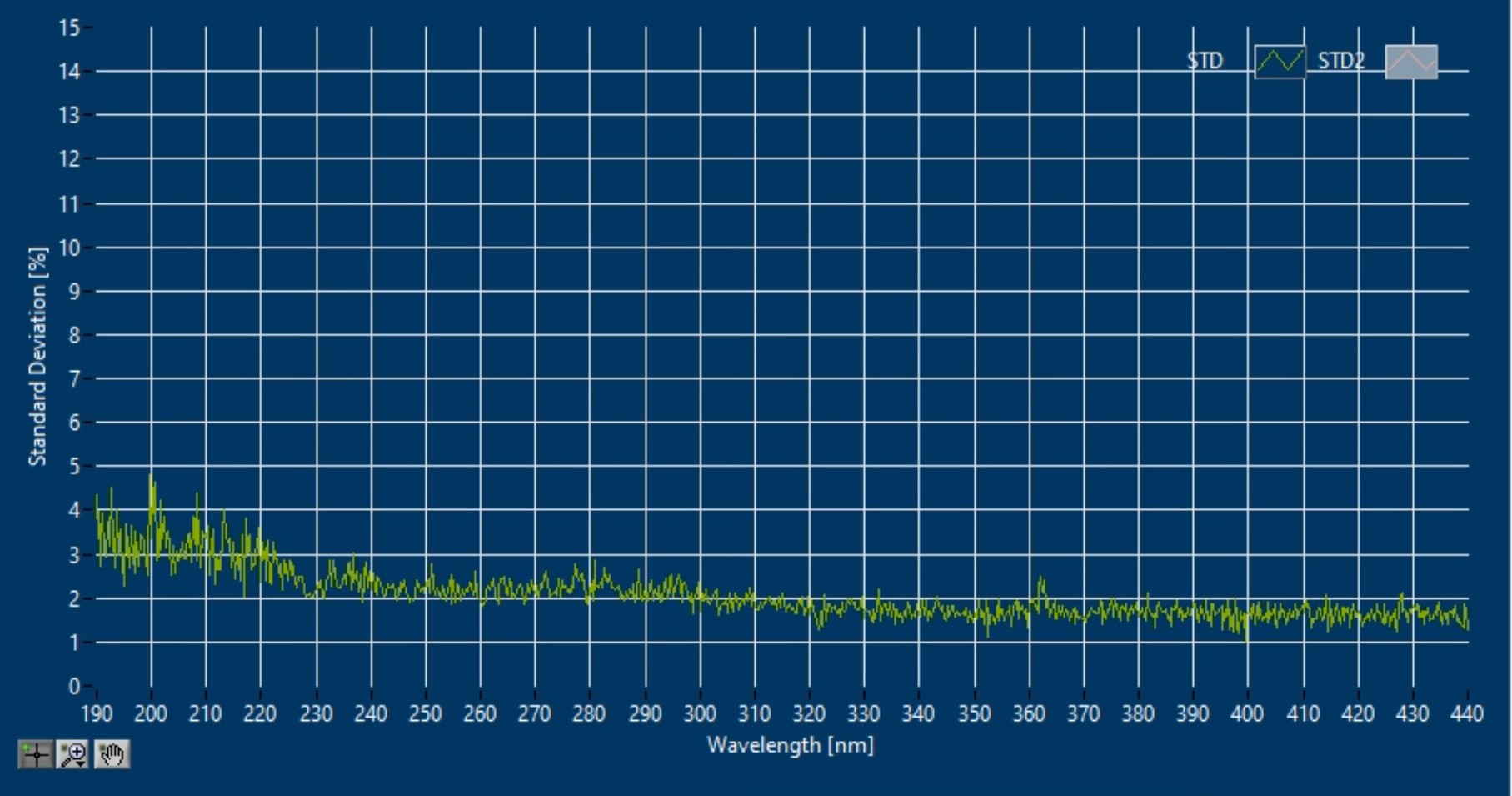
Because the variation is random from flash to flash, averaging N flashes reduces it by about √N: 16 flashes bring 2 % down to roughly 0.5 %. A reference detector that sees every flash corrects most of the remaining variation, which is the standard design for pulsed-source spectrometers. For radiometric checks of any source, see integrating sphere or cosine corrector and spectral transmittance measurement.
How to choose a broadband light source by application
| Application | Usual first choice | Why |
|---|---|---|
| UV–VIS absorbance spectroscopy | Deuterium + halogen, or pulsed xenon | Continuous UV and visible coverage; pulsed xenon for compact, low-heat instruments |
| NIR spectroscopy to 2.5 µm | Quartz tungsten halogen | Smooth NIR output, excellent stability, low cost |
| Fiber-coupled or micro-spot UV–VIS | Laser-driven plasma | Highest radiance from deep UV to NIR |
| Colour, reflectance and on-line process measurement | Pulsed xenon or multi-LED | Instant-on, cool running, gated detection rejects ambient light |
| Solar simulation | Xenon arc or pulsed xenon with filters | Daylight-like visible spectrum; classified per IEC 60904-9 |
| Machine-vision and inspection lighting | White or multi-LED | Efficiency, life, electronic control |
| Single-mode fiber, OCT-type or confocal work | Supercontinuum | Spatially coherent broadband light |
| Pulsed UV treatment and photolysis | Pulsed xenon | High peak UV including the 200–280 nm band, no mercury |
Whatever you choose, assess the photobiological hazard of the finished source. IEC 62471 classifies lamps and lamp systems by their UV, blue-light and IR exposure, and broadband UV-rich sources usually need shielding and interlocks.
Common mistakes when choosing a broadband source
Comparing watts instead of radianceétendue
A larger lamp is not a brighter lamp. Into a fiber or a slit, the coupled power follows radiance, so compare emitter sizes and run the étendue numbers before comparing electrical power.
Assuming the UV is therethermal sources
Check the spectral radiance at your shortest wavelength, not the range on a datasheet. A halogen lamp that is specified from 350 nm may deliver 1 % of its red-end radiance at 300 nm.
Ignoring the spectral slopedynamic range
A spectrum that changes by 100 times across the band needs 100 times more dynamic range at the detector, or filters to flatten it. Plan exposure for both ends of the band.
Measuring before warm-updrift
Continuous lamps drift for tens of minutes after switch-on. Log the output until it settles, then fix the warm-up time in the test procedure, or use a reference channel.
Forgetting the linesxenon and LEDs
Xenon line groups between 800 and 1000 nm and the dip in a white-LED spectrum near 480 nm show up as structure in a ratio if the sample and the reference see different optics. Keep the reference path as close as possible to the sample path.
IZAK products for this application
For a pulsed broadband source that is ready to integrate, or for measuring the spectrum and stability of the source you already use, these are the starting points.
 UV–VIS–IR light sourcePXL Scientific Pulsed Xenon Lamp ModuleBroadband pulsed light, 500–850 V in 8 steps, 0.2–2 Hz or single pulse, up to a few J per pulse, 12 VDC; standalone, USB or analog control.View product →
 RadiometryMulti-Channel Spectro-RadiometerCustom radiometer and spectroradiometer channels with narrow-FOV telescope optics and a flat 5 MHz bandwidth for fast source measurements.View product →
Most electronic, mechanical and optical parameters of the lamp module can be customized. For a complete illumination sub-system or test station, see custom electro-optical system design.
Frequently asked questions
QWhat is the best broadband light source for spectroscopy?
QWhy does a halogen lamp have so little UV?
QWhat is étendue and why does it matter for a light source?
Standards referred to
- IEC 62471, Photobiological safety of lamps and lamp systems.
- IEC 60904-9, Photovoltaic devices – Part 9: Classification of solar simulator characteristics.
- ISO/CIE 11664-2, Colorimetry – Part 2: CIE standard illuminants.
Tzachi Sabati
CEO, IZAK Scientific
Physicist specializing in photonics and quantum technologies, with deep expertise in quantum sensors and advanced optical systems. Leads the Advanced Quantum Lab course at the Technion, bridging academic excellence with industry innovation. At IZAK Scientific, provides cutting-edge photonics-based solutions, developing customized inspection and sensing systems for R&D and production. Passionate about advancing quantum sensing applications and integrating novel technologies to meet industry needs.
Get new IZAK guides and tools by email
One short email a month: new technical articles, free calculators and product updates in laser measurement and electro-optics. No spam, unsubscribe anytime.
