

In short
- MWIR lasers are demanding. Holmium (~2.1 µm), thulium (~2.0 µm) and Er:YAG (~2.94 µm) lasers in medicine, cutting and welding in industry, IR countermeasures and LIDAR in defense: high peak power, pulsed or CW.
- The profiler must see both the peak and the edges. High dynamic range and a cooled detector capture the intense centre and the faint spill-over without saturating.
- Eleven models, 1.5–5.7 µm. IZAK’s MWIR line runs from a cost-effective 320×256 model to a 2.95 MP model and a 1,004 Hz model with sub-frame rates up to 30,330 Hz.
- Choose by five questions: wavelength, beam size, how fast the beam changes, power and dynamic range, and integration. The finder below does the first pass for you.
Why MWIR lasers need a dedicated beam profiler
Mid-wave infrared (MWIR) lasers, roughly 1.5 to 5.7 µm, are at work across medicine, industry and defense. Holmium (~2.1 µm), thulium (~2.0 µm) and Er:YAG (~2.94 µm) lasers are used in surgery; MWIR lasers cut and weld in industrial processing; and defense and aerospace programs use them for IR countermeasures and LIDAR. In all of these, beam profiling is essential for performance and for safety.
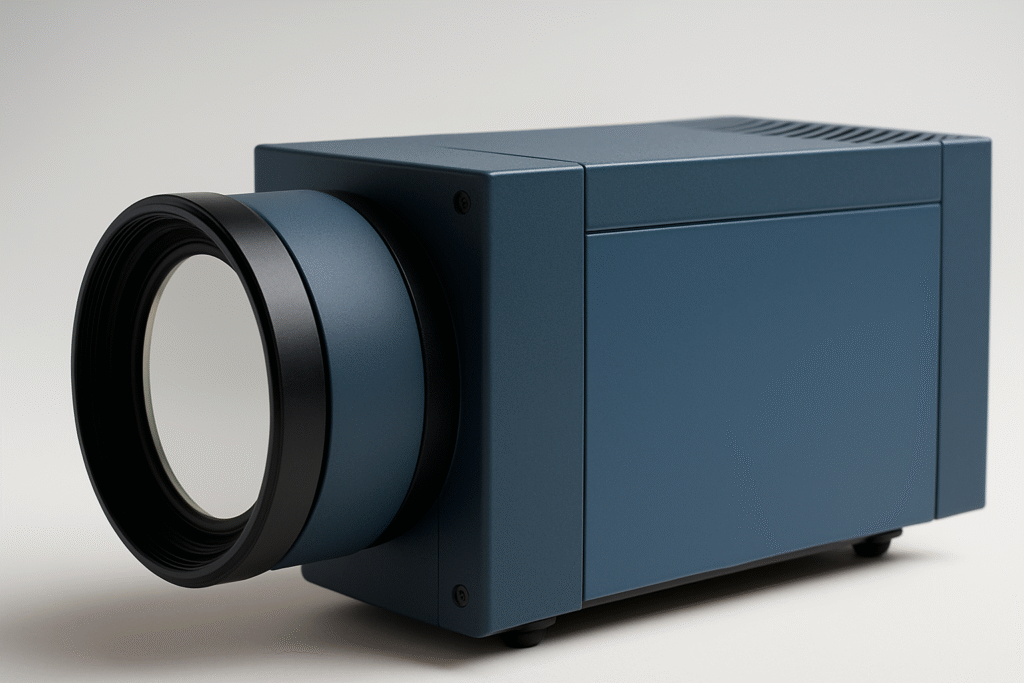
MWIR lasers often run at high peak power, in pulsed or CW mode. A beam profiler for them must capture both the intense central peak and the faint spill-over at the edges of the beam without saturating, so dynamic range matters [1]. MWIR sensors also need cooled detectors for sensitivity and low noise [1]. To meet these needs, IZAK Scientific has expanded its Laser Beam Profiler line to cover about 1.5–5.7 µm with the MWIR beam profiler family.
Key applications for MWIR beam profiling
Ho:YAG and thulium fiber lasers (~2.0 µm) for surgical cutting and lithotripsy; Er:YAG (~2.94 µm) for skin resurfacing, dental surgery and ophthalmology.
MWIR lasers (~2–5 µm) for precision machining of plastics and glass, cutting and welding.
IR countermeasures and LIDAR/LADAR, including military test ranges with time-stamped measurements.
OPO design, quantum cascade laser characterization and MWIR entanglement for quantum imaging.
Medical and biomedical
Ho:YAG and thulium fiber lasers (~2.0 µm) are used for surgical cutting and lithotripsy, and Er:YAG lasers (~2.94 µm) for skin resurfacing, dental surgery and ophthalmology. A beam profiler verifies spot size, focus quality and energy distribution before and during use. The high peak power and pulse energy of these lasers call for a profiler with high dynamic range [1]. For complete medical laser test systems, see medical device development.
Industrial manufacturing
MWIR lasers (~2–5 µm) are used for precision machining of plastics and glass. Profilers monitor the mode structure and stability of the beam, so that cut widths and weld quality stay consistent. High-power systems need a profiler with cooling and attenuation features [2].
Aerospace and defense
MWIR lasers are used in IR countermeasures and LIDAR/LADAR. Profiling checks the beam shape and divergence against the design specification. Fast frame rates and trigger synchronization help track changes in pointing or pulsing, and on military test ranges measurements are time-stamped with IRIG-B.
Research and development
In the lab, MWIR profiling supports OPO design, quantum cascade laser (QCL) characterization and MWIR entanglement for quantum imaging (see nonlinear optics and its quantum impact). Researchers get real-time feedback on beam width, ellipticity and intensity profile. Older methods relied on scanning slits or pyroelectric devices; cooled MWIR cameras image 1.5–5 µm beams directly and enable single-shot 2D profiling of pulsed and CW lasers.
IZAK Scientific’s MWIR beam profiler line-up
All IZAK MWIR beam profilers use cooled focal-plane array detectors and come with IZAK’s analysis software. They offer snapshot acquisition, integrated attenuation and high-speed interfaces, and all models are available as variants on the Laser Beam Profiler product page.
| Model | Spectral range | Resolution / pitch | Frame rate | Bit depth / accuracy | Interfaces and sync | Attenuation |
|---|---|---|---|---|---|---|
| MWIR-1 | 3.7–4.8 µm | 320×256 (0.08 MP) | Up to 75 Hz | 14-bit | GigE; built-in cooler | 5-position filter wheel, 5-position aperture wheel |
| MWIR-2 | 3.7–4.8 µm | 320×256 (0.08 MP), high speed | 481 Hz full frame; higher with sub-windowing | 16-bit · ±1% | GigE; 4 IN / 2 OUT TTL triggers; analog I/O | 5-position filter wheel, 5-position aperture wheel |
| MWIR-3 | 1.5–5.7 µm | 640×512 (0.33 MP) · 15 µm | 75 Hz | 14-bit · ±2% | GigE | 7-position motorized ND filter wheel, 5-position aperture wheel |
| MWIR-4 | 1.5–5.7 µm | 640×512 (0.33 MP) | Up to 151 Hz | 16-bit · ±1% | GigE, optional Camera Link; 4 IN / 2 OUT triggers; analog signals | 7-position filter wheel, 5-position aperture wheel |
| MWIR-5 (flagship) | 1.5–5.7 µm | 640×512 (0.33 MP) | Up to 232 Hz | 16-bit · ±1% | GigE and 10 GigE; dual Camera Link; IRIG-B time stamps | 7-position filter wheel, 5-position aperture wheel |
| MWIR-6 | 1.5–5.5 µm | 640×512 (0.33 MP) · 25 µm | Up to 1,004 Hz; sub-frame up to 30,330 Hz | 14-bit · ±1% | 10 GigE | 7-position filter wheel, 5-position aperture wheel |
| MWIR-7 | 1.5–5.5 µm | 1280×1024 (1.3 MP) · 10 µm | Up to 180 Hz; sub-frame up to 2,601 Hz | – | GigE, 10 GigE, Camera Link, HDMI; 4 IN / 2 OUT TTL; analog; IRIG-B | Motorized 7-position filter wheel, 5-position aperture wheel |
| MWIR-8 | 1.5–5.5 µm | 640×512 (0.33 MP) · 20 µm | Up to 622 Hz; sub-frame up to 3,343 Hz | 16-bit · ±1% | 10 GigE, Camera Link, HDMI; advanced sync | Motorized 7-position filter wheel, 5-position aperture wheel |
| MWIR-9 | 1.5–5.5 µm | 1280×1024 (1.3 MP) · 10 µm | Up to 180 Hz; high-speed mode up to 3,343 Hz | 16-bit · ±1% | GigE, 10 GigE, Camera Link, HDMI; advanced triggers | Integrated attenuation |
| MWIR-10 | 3.5–4.8 µm | 1280×720 (0.92 MP) · 12 µm | Up to 120 Hz; sub-frame up to 16,053 Hz | 14-bit · ±1% | GigE, 10 GigE, dual Camera Link, HDMI | – |
| MWIR-11 | 3.6–4.9 µm | 1920×1536 (2.95 MP) | Up to 113 Hz; high-speed up to 2,493 Hz | 14-bit · ±1% | 10 GigE, HDMI; flexible trigger and analog sync | – |
Full frame = whole sensor; sub-frame = a smaller region of interest read out faster. MWIR-1 is the cost-effective entry model with a built-in cooler; MWIR-5 is the flagship model. Exact specifications and active areas for each variant are on the MWIR beam profiler page.
Software included with every model
Every MWIR model comes with the IZAK Beam Profiler software. It measures beam width and diameter, profile shape, ellipticity, centroid, divergence and more [1], shows the beam in 2D and 3D, and tracks changes over time so you can adjust the laser in real time. The motorized filter and aperture wheels adapt to the power level and beam size without manual intervention, which also protects the sensor.

Which MWIR profiler fits your laser?
Enter the wavelength, the beam diameter at the sensor and the frame rate you need. The finder lists the models that cover them and checks the beam against the sensor: at least 10 pixels across the beam, and no more than about one third of the sensor width.
Pixels across the beam = beam diameter ÷ pixel pitch. Sensor fill = beam diameter ÷ (horizontal pixels × pitch). Where the pitch is not published, we confirm the fit with you. To size the beam at the sensor, use the Gaussian Beam Calculator.
Selecting the right MWIR beam profiler
Five questions narrow the choice.
1. Wavelength coverage
For lasers at about 3.7–4.8 µm, such as quantum cascade lasers and other mid-IR sources in that band, the narrow-band MWIR-1 or MWIR-2 is a good fit. For 1.5–5.7 µm (Ho:YAG at 2.1 µm, Er:YAG at 2.9 µm, or lasers beyond 5 µm), choose a broadband model: MWIR-3, MWIR-4 or MWIR-5. MWIR-6 to MWIR-9 cover 1.5–5.5 µm, and the high-resolution MWIR-10 and MWIR-11 cover 3.5–4.8 µm and 3.6–4.9 µm.
2. Beam size and resolution
Infrared camera pixels are typically 15–30 µm, larger than in visible cameras. Beams of a few hundred microns therefore need a VGA (640×512) or higher-resolution model, so that enough pixels cover the beam. The QVGA (320×256) sensors of MWIR-1 and MWIR-2 may suffice for large beams. For the smallest beams, the 10–12 µm pitch of MWIR-7, MWIR-9 and MWIR-10 gives the most pixels across the beam.
3. Temporal dynamics
For slowly varying or CW beams, 75 Hz (MWIR-1, MWIR-3) is adequate. For pulse-to-pulse fluctuations and jitter, MWIR-2 (481 Hz full frame) is a strong choice, and MWIR-5 (232 Hz) gives fast monitoring with a large frame. For the highest speeds, MWIR-6 reaches 1,004 Hz full frame and 30,330 Hz in sub-frame mode, and MWIR-10 reaches 16,053 Hz in sub-frame mode.
4. Power and dynamic range
The 16-bit models (MWIR-2, MWIR-4, MWIR-5, MWIR-8 and MWIR-9) distinguish subtle intensity variations in high-power or high-contrast beams. MWIR-3 to MWIR-8 have a 7-position ND filter wheel, compared with 5 positions on MWIR-1 and MWIR-2, which helps avoid saturation. Higher dynamic range supports accurate, linear measurements [1].
5. Integration and advanced features
Any model connects to a PC over standard GigE for stand-alone lab use. MWIR-4 and MWIR-5 offer multiple trigger I/O lines; MWIR-5 adds 10 GigE, dual Camera Link and IRIG-B, which suits defense and aerospace work. MWIR-4 offers similar synchronization at lower cost, without the highest throughput, and MWIR-1, MWIR-2 and MWIR-3 suit simpler set-ups. MWIR-7 to MWIR-11 add HDMI output and 10 GigE for high data rates.
All IZAK profilers are delivered calibrated. If you are not sure which model fits, send us your laser specifications and we will match them to a model.
Customization and integration capabilities
Beyond the standard models, IZAK adapts the profiler to the application, as a stand-alone lab profiler or as part of a turnkey automated inspection system:
- Software: tailored measurement workflows, custom output formats for existing QA systems, and automated pass/fail algorithms for production lines.
- Optical attenuation: additional attenuation stages with ND filters and beam splitters.
- Extra measurement modules: beam power, energy per pulse, and fast temporal pulse-shape measurement with a photodiode, integrated on the TriBeam Precision platform [2].
- Inspection-system integration: temperature sensors, motion-control stages, data logging and reporting, and application-specific image processing. See electro-optical system design and development.
See the beam profiler in action
See demo – Basic operation of IZAK’s Beam Profiler application
See demo – Test and report feature
See demo – Fractional laser beam profiler feature
Engineering tool
Gaussian Beam CalculatorRayleigh range, divergence and beam size at any distance: check the beam diameter that will reach the MWIR sensor.Conclusion
MWIR lasers bring high peak powers, fast dynamics and wavelengths that ordinary cameras cannot see. With eleven MWIR models, high dynamic range, motorized attenuation and software built for test and QA, IZAK Scientific helps healthcare, manufacturing, defense and research teams measure these beams with confidence, and the wider IZAK line covers lasers from UV through LWIR [3]. All models are available as variants on the Laser Beam Profiler page, with specifications for comparison.
Related reading: The Essentials of Laser Beam Profiling, AI analytics for laser beam profiling and laser beam profiling across industries.
References. [1] IZAK Scientific, Laser Beam Profiler selection guide. [2] IZAK Scientific, TriBeam Precision. [3] IZAK Scientific, Illuminating Precision: laser beam profiling across industries.
Frequently asked questions
QWhich wavelengths does an MWIR beam profiler cover?
QCan I profile a 2 µm thulium or holmium laser?
QWhy do MWIR profilers need high dynamic range and attenuation?
Tzachi Sabati
CEO, IZAK Scientific
Physicist specializing in photonics and quantum technologies, with deep expertise in quantum sensors and advanced optical systems. Leads the Advanced Quantum Lab course at the Technion, bridging academic excellence with industry innovation. At IZAK Scientific, provides cutting-edge photonics-based solutions, developing customized inspection and sensing systems for R&D and production. Passionate about advancing quantum sensing applications and integrating novel technologies to meet industry needs.
