

In short
- Nonlinear optics starts where intensity matters. At high intensity a material’s polarisation is no longer proportional to the field, and the χ⁽²⁾ and χ⁽³⁾ terms generate new frequencies.
- Four processes do most of the work: second-harmonic generation (SHG), sum- and difference-frequency generation (SFG, DFG) and optical parametric oscillation (OPO).
- Phase matching decides efficiency. The crystal angle and temperature must make the wave vectors match; a fraction of a degree of misalignment costs efficiency.
- It is the engine of quantum optics. Spontaneous parametric down-conversion (SPDC) produces entangled photon pairs, and frequency conversion links quantum memories to telecom channels. Use the calculator below for wavelengths and phase-matching angles.

Nonlinear optics (NLO) studies the interaction of light with matter when the material responds nonlinearly to the light. In linear optics, properties such as refraction and absorption do not depend on the light intensity. In nonlinear optics, these properties change significantly as the intensity rises [1]. This article explains the fundamentals, the key processes, why nonlinear optics is central to quantum technologies, and what it takes to make it work in practice.
Fundamentals of nonlinear optical processes
In a linear medium, the polarisation P (the induced dipole moment per unit volume) is directly proportional to the electric field E of the light, scaled by the linear susceptibility χ⁽¹⁾:
P = ε₀ χ⁽¹⁾ E
At higher intensities the relationship becomes nonlinear and is written as a power series:
P = ε₀ (χ⁽¹⁾E + χ⁽²⁾E² + χ⁽³⁾E³ + …)
Here χ⁽²⁾ and χ⁽³⁾ are the second- and third-order nonlinear susceptibilities. These terms generate new frequencies or change the properties of the incoming light [2]. The χ⁽²⁾ term exists only in crystals without a centre of symmetry, which is why frequency doubling and parametric processes use special birefringent crystals; χ⁽³⁾ effects, such as the optical Kerr effect and four-wave mixing, occur in all materials, including glass fibres.
Key nonlinear optical processes
Two photons at frequency ω combine into one photon at 2ω, for example 1064 nm into 532 nm.
Photons at ω₁ and ω₂ combine into one photon at ω₁ + ω₂, for example 1064 nm + 532 nm into 355 nm.
Produces photons at ω₁ − ω₂. It is important for quantum frequency conversion and for reaching the mid-infrared.
In a crystal inside a resonator, a pump photon splits into a lower-energy signal and idler pair. The output is tuned by changing the crystal angle [3].
In every one of these processes energy is conserved, ωpump = ωsignal + ωidler, and the conversion is efficient only when momentum is conserved too. This is the phase-matching condition:
kpump = ksignal + kidler
where k = 2πn/λ is the wave vector, which depends on the refractive index n and the frequency. Because of dispersion, the three waves normally travel at different phase velocities and the generated light interferes destructively along the crystal. In a birefringent crystal, the crystal orientation sets the effective refractive indices of the interacting waves so that the condition is met. Changing the crystal angle changes the indices and fine-tunes the output wavelength [4]. Temperature changes the indices as well, which is why many set-ups also stabilise the crystal temperature.
Nonlinear wavelength and phase-matching calculator
Choose a process and enter the wavelengths. The tool applies energy conservation to find the generated wavelength(s) and photon energies, and solves the type-I birefringent phase-matching angle (o + o → e) in a beta-barium borate (BBO) crystal, one of the most common crystals for SHG, SFG and SPDC.
Energy conservation: 1/λ₃ = 1/λ₁ + 1/λ₂. Type-I phase matching: no(λ₁)/λ₁ + no(λ₂)/λ₂ = ne(θ, λ₃)/λ₃, with 1/ne(θ)² = cos²θ/no² + sin²θ/ne², using a published BBO Sellmeier dispersion model (valid roughly 0.2–2.5 µm). Angles are internal and for a crystal at room temperature; check walk-off, acceptance angle and temperature for your design.
Quantum significance of nonlinear optics
Nonlinear optics is central to the development of quantum technologies. Spontaneous parametric down-conversion (SPDC), a special case of nonlinear frequency conversion in which a pump photon splits into two photons without a seed, is a primary source of entangled photon pairs. These pairs underpin quantum communication, quantum cryptography, quantum computing and quantum-enhanced sensing [5]. Our articles on understanding photon entanglement and photon entanglement applications show how such pairs are measured and used.
During SPDC, precise control of the crystal angle determines the spatial geometry of the emitted photons: whether they leave as a collinear beam or as cones, and where those cones overlap. Even small misalignments change the emission angles, the pair correlations and, ultimately, the quality of the entanglement [6]. You can see this sensitivity in the calculator above: with a 405 nm pump, tilting the crystal by only about 0.02° moves the phase-matched signal from 810 nm to 780 nm.
Nonlinear optics also enables quantum frequency conversion, which lets different quantum systems, such as quantum memories, processors and telecom channels, interact efficiently while preserving the quantum state of the light [7]. The same nonlinear crystals generate the squeezed light used in quantum sensing.
Practical challenges in implementing nonlinear optics
Efficient nonlinear processes require precise phase matching, accurate crystal alignment, temperature stability and, in electro-optic applications, controlled electrical modulation. Misalignment or temperature drift can noticeably reduce the efficiency and the fidelity of quantum processes [8]. In practice, this means the crystal mount must combine fine translation, fine angular adjustment about two axes, temperature control and, where needed, electrical connection to the crystal, all without drifting over hours of measurement.

Optimizing nonlinear optics with the IZAK NLO kinematic mount
To meet these challenges, IZAK Scientific developed the NLO kinematic mount, now offered as the QuantumAlign NLO kinematic stage, designed specifically for nonlinear optical applications. It provides:
- X and Y translation for accurate crystal positioning.
- Controlled rotation about the X and Y axes for precise phase matching.
- Direct high-voltage application to the crystal, for electro-optic modulation.
- Integrated temperature control for crystal stability and consistent nonlinear interactions.
Combining these capabilities in one mount improves performance, reliability and convenience in quantum optics experiments and in industrial quantum photonics. For complete set-ups, from pump laser and crystal to detection and timing electronics, see our electro-optical system design and development services.
In future articles of our Second Quantum Revolution series, we continue to explore how nonlinear optics shapes quantum technology.
IZAK products for this application
Instruments from our catalog that match the measurements and set-ups in this article.
 Quantum opticsQuantumAlign NLO Kinematic StagePosition nonlinear crystals with X–Y translation, tip and tilt.View product →
 Electro-optic driversHigh Voltage SwitcherDrive Pockels cells for Q-switching and pulse picking.View product →
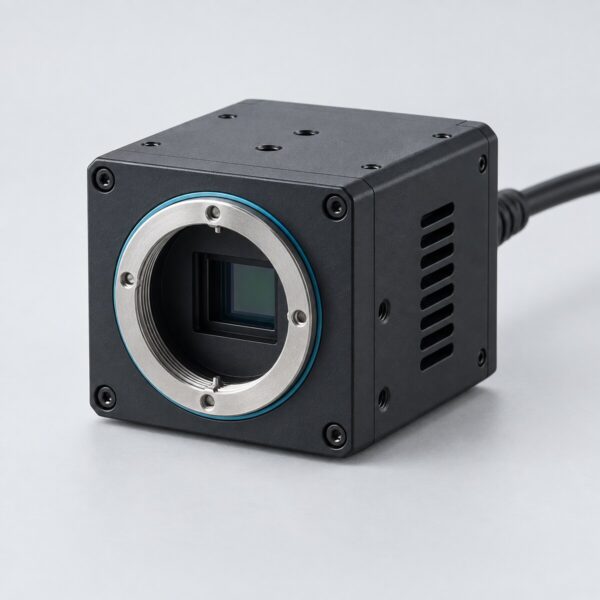 Laser metrologyLaser Beam ProfilersUV to LWIR families, packaged, OEM or software, with Test mode and reports.View product →
Need something that is not in the catalog? We design custom electro-optical systems →
References
- Boyd, R. W. (2008). Nonlinear Optics (3rd ed.). Academic Press.
- Shen, Y. R. (2002). The Principles of Nonlinear Optics. Wiley-Interscience.
- Saleh, B. E. A., & Teich, M. C. (2007). Fundamentals of Photonics (2nd ed.). Wiley.
- Dmitriev, V. G., Gurzadyan, G. G., & Nikogosyan, D. N. (1999). Handbook of Nonlinear Optical Crystals (3rd ed.). Springer.
- Gerry, C., & Knight, P. (2005). Introductory Quantum Optics. Cambridge University Press.
- Kwiat, P. G., Mattle, K., Weinfurter, H., Zeilinger, A., Sergienko, A. V., & Shih, Y. (1995). New high-intensity source of polarization-entangled photon pairs. Physical Review Letters, 75(24), 4337–4341.
- Kumar, P. (1990). Quantum frequency conversion. Optics Letters, 15(24), 1476–1478.
- Yariv, A., & Yeh, P. (2006). Photonics: Optical Electronics in Modern Communications (6th ed.). Oxford University Press.
Frequently asked questions
QWhat is phase matching in nonlinear optics?
QWhat is the difference between SHG, OPO and SPDC?
QHow precisely must a nonlinear crystal be aligned?
Tzachi Sabati
CEO, IZAK Scientific
Physicist specializing in photonics and quantum technologies, with deep expertise in quantum sensors and advanced optical systems. Leads the Advanced Quantum Lab course at the Technion, bridging academic excellence with industry innovation. At IZAK Scientific, provides cutting-edge photonics-based solutions, developing customized inspection and sensing systems for R&D and production. Passionate about advancing quantum sensing applications and integrating novel technologies to meet industry needs.
