

In short
- The client: a start-up developing an aesthetic medical device based on a xenon flash lamp, on a confidential electro-optics platform.
- The challenge: choose the right lamp by efficacy, efficiency, wavelength spectrum, human safety and light–tissue interaction.
- The solution: a test set-up with a spectrometer, a filtered photodiode, a power meter, an A/D converter and a power supply, run by one LabVIEW application.
- The result: in about one month, a full performance envelope for the platform and a recommended light source for each application.
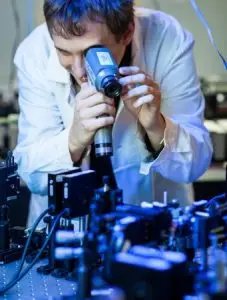
The challenge: is a xenon flash lamp suitable?
A start-up developing an aesthetic medical device based on a xenon flash lamp needed fast prototypes and a complete development solution for its confidential electro-optics platform.
The project evaluated a full xenon lamp design for the platform. To select the right lamp, we tested each candidate for efficacy, efficiency, wavelength spectrum, human safety, the interaction of the light with tissue and other characteristics.
The test set-up
We assembled a test set-up for the most viable lamps, built from these instruments:
Monitors the wavelengths the lamp emits.
Records the temporal pulse profile: its shape and width.
Operates the devices and collects precise signals.
Measures the optical pulse energy.
Drives the lamp at controlled voltage and current.
What we were responsible for
- Define the criteriafor recommending the most suitable flash lamp
- Specify the measurementsthat would show success or failure
- Recommend the componentsto buy or rent, as needed
- Write the softwarethat links all devices to quantify and organize the results
- Carry out the measurementsand change the methods when the results required it
- Analyze the resultsand recommend the best lamp for the client’s purpose
Four measurements for every lamp setting
A LabVIEW software routine controlled the lamp’s voltage and current, operated the spectrometer and collected the raw sensor data, so the same set-up could be used across many settings. For each setting it measured:
- Lamp spectrum, with the spectrometer.
- Time-dependent profile of the light, with the photodiode.
- Optical pulse energy, with the power meter.
- Electrical power consumed, with a set of electrical power sensors.
All characteristics were synchronized and saved to one unified file. The data were analyzed in the loop and condensed into a few parameters, which we used to present the decision to the client.
Together, these measurements give the numbers that decide whether a lamp is suitable: the electrical-to-optical efficiency, the fluence at the treatment area, the share of the energy in the useful spectral band, and how hard the lamp is driven compared with its limits. Read more about the xenon flash lamp spectrum and applications for pulsed flash lamps.
LabVIEW software design tips from this project
- Modular design. The application was built as a state machine, so instruments and steps could be added or changed quickly.
- Write every measurement directly to file, without buffers. Data survived errors, power failures and shutdowns: every measurement was transferred and no data were lost.
- Keep all raw data. All raw data were saved and analyzed by a dedicated analyzer, so results could be re-processed later.
Flash lamp energy, efficiency and loading
Enter the discharge and lamp parameters and the optical energy you measured. The tool gives the electrical-to-optical efficiency, the fluence and how close the pulse is to the lamp’s single-shot limit. The values below are an example; enter your own.
Electrical energy = ½·C·V². Explosion energy Ex = 1.2×10⁴ · arc length (cm) · bore (cm) · √(pulse width in s), a widely used estimate for xenon lamps at typical fill pressure. Life ≈ (E/Ex)−8.5 flashes. A first estimate for comparing lamps: above about 10⁸ flashes, electrode wear and average power set the life, and the lamp datasheet always takes priority.
The result
Within one month we built a full performance envelope for the platform and recommended a light source for each potential application. The relationship with the client grew from this project, and we are still in contact.
Calibration and verification of the final device follow the same principles; see our case study on automated calibration for IPL and laser-based medical devices.
Have a similar challenge?
We offer the same custom process for your technology challenges: defining the criteria, building the test set-up and software, measuring and recommending. Learn more about our medical device development work and the PXL Scientific pulsed xenon lamp module.
Frequently asked questions
QAre xenon flash lamps suitable for aesthetic medical devices?
QWhat should be measured when selecting a flash lamp?
QHow does pulse energy affect flash lamp life?
Tzachi Sabati
CEO, IZAK Scientific
Physicist specializing in photonics and quantum technologies, with deep expertise in quantum sensors and advanced optical systems. Leads the Advanced Quantum Lab course at the Technion, bridging academic excellence with industry innovation. At IZAK Scientific, provides cutting-edge photonics-based solutions, developing customized inspection and sensing systems for R&D and production. Passionate about advancing quantum sensing applications and integrating novel technologies to meet industry needs.
