

In short
- What it is. A pulsed flash lamp produces short bursts of very intense, broadband light, packing high energy into a brief pulse.
- Where it is used. Photography, stroboscopes, high-speed imaging, industrial inspection, spectroscopy, laser pumping, IPL medical and cosmetic devices, fluorescence microscopy, research and stage effects.
- Design follows the job. Flash energy, pulse width, repetition rate and cooling differ for each application, and they decide the lamp life.
- Size it first. Use the calculator below to estimate the explosion energy, the expected number of flashes and the wall loading of your lamp.

Pulsed flash lamps are devices that emit short bursts of intense light. Because they deliver high-energy light pulses over a very short time, they are used in a wide range of fields, from a camera flash to the pump source of a solid-state laser and the light engine of an IPL medical device. Below are the most common applications, followed by a calculator for sizing a lamp and an overview of IZAK Scientific’s xenon lamp drivers.
Common applications of pulsed flash lamps
1. Photographylow light, frozen motion
Flash lamps provide additional light in low-light conditions. A pulsed flash delivers a short, intense burst of light that illuminates the scene, freezes motion and captures sharp images.
2. Stroboscopic lightingsports, dance, industry
Pulsed lamps produce a series of rapid, synchronized flashes. They are used in sports and dance photography and in industrial applications to capture high-speed motion and reveal details that continuous light would blur.
3. High-speed imagingballistics, crash tests, fluid dynamics
High-speed imaging systems use short, high-intensity pulses to capture fast events. Examples include ballistics research, crash testing and fluid-dynamics studies.
4. Industrial inspectionquality control, defect detection
Flash lamps are used in quality control and defect detection. Short pulses illuminate specific features of a part for inspection, without motion blur on a moving line.
5. Spectroscopybroadband excitation and absorption
In spectroscopic instruments, flash lamps provide broadband light for sample analysis. The intense pulses can excite atoms or molecules so researchers can study their spectra. See Xenon Flash Lamps in Classical and Quantum Innovations for the spectrum and the research uses in detail.
6. Pumped light sourcesexcitation of a gain medium
Flash lamps are often used to pump lasers. The flash excites the gain medium inside the laser cavity, which then produces coherent laser pulses.
7. Medical and cosmetic applicationsIPL: hair removal, skin rejuvenation, vascular lesions
Pulsed flash lamps are the light source of intense pulsed light (IPL) systems, used for hair removal, skin rejuvenation and the treatment of vascular lesions. Read how IZAK built automated calibration for IPL and laser-based medical devices, and see our medical device development services.
8. Laser systemsNd:YAG and ruby lasers
Flash lamps pump several types of lasers, including Nd:YAG and ruby lasers, providing the energy the gain medium needs to generate laser light.
9. Fluorescence microscopyfluorophore excitation
Pulsed flash lamps excite fluorophores. Short pulses reduce photobleaching and improve the signal-to-noise ratio.
10. Scientific researchphysics, chemistry, materials science
Flash lamps serve many research applications that need intense, short light pulses, in physics, chemistry and materials science.
11. Entertainment and special effectsconcerts, theatre, events
Pulsed flash lamps create dramatic visual effects with short bursts of light at concerts, theatrical performances and events.
The design and characteristics of a pulsed flash lamp vary with the application. A photography lamp has very different requirements from a lamp in a scientific instrument or a medical device: flash energy, pulse width, repetition rate, spectrum, cooling and required life all change. The high-voltage trigger and switching that fire the lamp matter too; see The Role of High Voltage Switches in Optics.
Flash lamp life and wall-loading calculator
Enter the lamp’s arc length and bore, the pulse width, the energy per flash and the repetition rate. The tool estimates the single-shot explosion energy, the expected number of flashes, the average power and the wall loading, and suggests the cooling the lamp needs.
Explosion energy Ex = 2.5×10⁴ · l · d · √t (J, with arc length l and bore d in cm and pulse width t in s), for a quartz xenon lamp. Life N ≈ (E/Ex)−8.5 flashes. Wall loading = E·f / (π·d·l). Guide limits: about 15 W/cm² with free air, 40 W/cm² with forced air and 200 W/cm² with liquid cooling. Below about 30% of Ex, electrode wear and wall loading, not explosion, set the real life; above about 10⁷ flashes the estimate is only an upper bound.
IZAK Scientific xenon lamp systems
IZAK Scientific offers two xenon lamp drivers that operate the lamp at high voltage:
For low-power xenon lamps: operating voltage up to 1 kV and repetition rate up to 3 Hz, with a 5–10 kV ignition pulse. Suited to spectroscopy and other low-intensity, precise illumination.
For high-power lamps: operating voltage from 200 V to 4 kV and repetition rates up to 100 Hz, for high-power applications such as solar simulation and pulsed-light sanitizing.
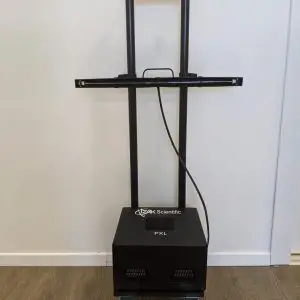
Both systems work with any xenon lamp and can be customized to your application. They are supplied with software and/or manual control. See the PXL pulsed xenon lamp module for details.


IZAK products for this application
Instruments from our catalog that match the measurements and set-ups in this article.
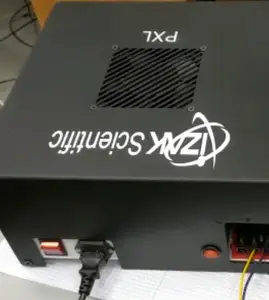
 Light sourcesPXL Scientific Pulsed Xenon Lamp ModulePulsed xenon light source for optical set-ups and test applications.View product →
 LampsAgeing ConsolesControlled burn-in and ageing tests for lamps and light sources.View product →
Need something that is not in the catalog? We design custom electro-optical systems →
Frequently asked questions
QWhat are pulsed flash lamps used for?
QHow long does a xenon flash lamp last?
QWhat does IZAK offer for xenon flash lamps?
Tzachi Sabati
CEO, IZAK Scientific
Physicist specializing in photonics and quantum technologies, with deep expertise in quantum sensors and advanced optical systems. Leads the Advanced Quantum Lab course at the Technion, bridging academic excellence with industry innovation. At IZAK Scientific, provides cutting-edge photonics-based solutions, developing customized inspection and sensing systems for R&D and production. Passionate about advancing quantum sensing applications and integrating novel technologies to meet industry needs.
