
Description
Laser beam analysis · UV to LWIR
Laser Beam Profiler
from software to turnkey
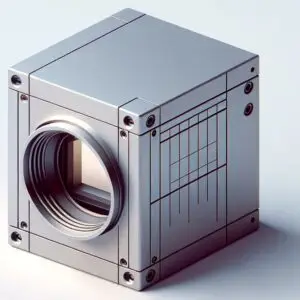
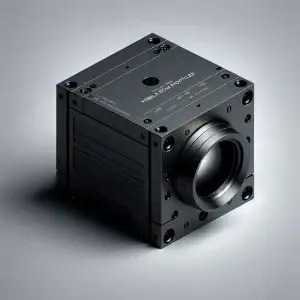
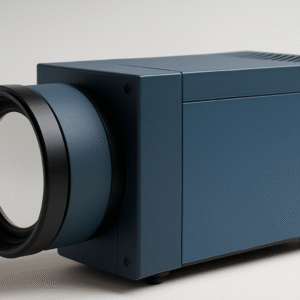
Choose the integration level that fits your optical system: software-only analysis, a compact OEM module, or a fully packaged beam-profiling system.
Microsoft Teams · pick a time that suits you · no obligation

Application demonstration
See the Laser Beam Profiler in action
A short walkthrough of the core application: live beam visualization, measured parameters and the practical measurement workflow.
Basic operation demonstration · Plays directly on this page.
One analysis platform, three delivery models
Start at the right integration level
Move from laboratory evaluation to embedded production without rebuilding the measurement workflow.
Software-only
Use IZAK analysis with a supported or customer-selected camera.
- Fast evaluation
- Flexible camera choice
- R&D and algorithm validation
OEM board-level module
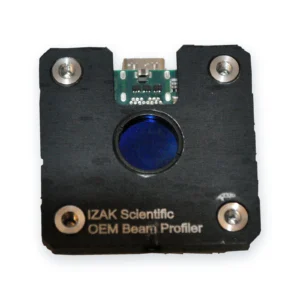
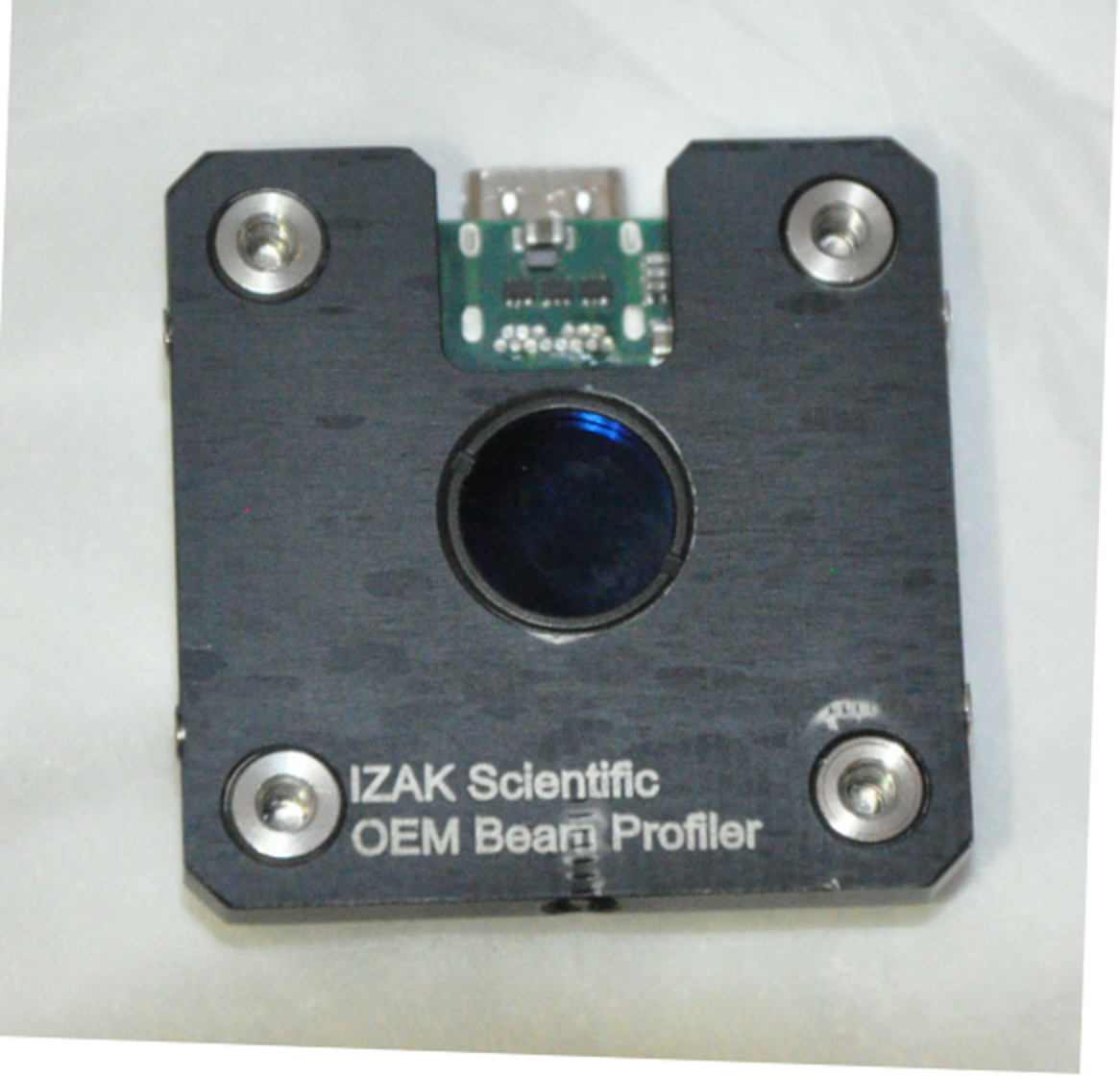
A compact beam-profiler engine for integration inside your instrument or automated tester. Board-level camera, no housing, powered over USB 3, from 7 g.
- Six standard models (SKU 35001–35006)
- Four with global shutter for pulsed lasers
- API control and production integration support
Packaged system
A complete, application-matched measurement solution ready for optical setup.
- Camera and optics matched
- Turnkey measurement workflow
- Configuration support
Broad spectral coverage
One profiling approach from UV to LWIR
General laser development, alignment and production testing.
Explore UV–VIS–NIR profilers →Telecom, sensing and near-infrared laser applications.
Explore SWIR profilers →Advanced mid-wave infrared application configurations.
Explore MWIR profilers →Thermal-infrared and CO₂-laser analysis with application-matched detectors.
Explore LWIR profilers →Measured parameters
Turn beam images into decisions
Measure, monitor and automate the parameters that matter for optical performance and pass/fail testing.
Production test demonstration
Test, pass/fail and report generation
See how measurement limits are converted into a repeatable production test and documented report.
Configure a production testTest and Report feature · Plays directly on this page.
Research & development
Explore and characterize
Capture detailed beam behavior while developing sources, optics and alignment strategies.
- Interactive analysis
- Configuration flexibility
- Exportable measurement data
Production & OEM
Automate and qualify
Embed repeatable profiling into test stations, instruments and quality-control workflows.
- Pass/fail criteria
- Automated acquisition
- Integration through API
Specialized application
Fractional laser beam analysis
Evaluate multiple beam spots, their positions and uniformity using the same analysis and automated-test approach.
Explore fractional beam profilingFractional Laser Beam Profiler · Plays directly on this page.
Built-in capability
AI insights and reporting
Built-in AI analytics turns measurement data into trend detection, production monitoring and clearer engineering reports—without changing the core profiler workflow.
AI Analytics and IZAK Insight Chat · Plays directly on this page.
Selected resources
Continue your evaluation
These resources are curated for this product page rather than selected automatically.
AI analytics for laser beam profiling
From production monitoring to R&D insight.
Read the article →Advanced MWIR beam profiling
Beam-profiler options for 1.5–5.7 µm laser applications.
Read the article →TriBeam Precision
A comprehensive platform for laser power, profiling and temporal measurements.
View the product →Buying guide
How to choose a laser beam profiler
Five questions decide the right laser beam profiler for your beam. Answer them in this order and the detector family, optics and software follow.
- What is the wavelength?The wavelength picks the profiler family: UV–VIS–NIR for 300–1100 nm, SWIR up to 2.05 µm, MWIR for 1.5–5.7 µm and LWIR for 7.7–12 µm. Lasers near 2 µm can be covered by SWIR or MWIR, so tell us the exact line.
- How large is the beam at the measurement plane?Aim for at least 10 pixels across the beam and a beam no wider than about one third of the sensor. Small focused spots need magnifying optics; large beams need reducing optics or an imaging screen.
- How much power or energy reaches the sensor?Camera sensors need only a tiny fraction of the beam. Most set-ups use attenuation or a beam sampler sized to the power, energy and wavelength, so the profile is measured without saturation or damage.
- Is the laser pulsed or CW?Pulsed lasers need a global-shutter model with an external trigger, so every frame captures a complete pulse. Continuous-wave beams can also use lower-cost rolling-shutter models.
- Where will it run?For R&D you need interactive analysis and data export. For production and OEM use you need pass/fail limits, automatic reports and API control from your test software.
Read the full selection guideSize your beam with the Gaussian beam calculator
Integration levels
Compare software-only, OEM and packaged profilers
| Software-only | OEM board-level module | Packaged system | |
|---|---|---|---|
| Best for | Fast evaluation, R&D, algorithm validation | Instruments, automated testers, production lines | Laboratories and test stations that need a ready set-up |
| What you get | IZAK beam analysis software for a supported or customer-selected camera | Board-level camera without housing, from 7 g, with IZAK software and API | Camera, optics and attenuation matched to your laser, with software |
| Interface | Your camera’s interface | USB 3, powered from the cable | Matched to the detector family |
| Pulsed lasers | Depends on the camera | Four of six standard models are global shutter | Configured for your pulse rate and trigger |
| Automation | Analysis, export, API | API control, pass/fail, production integration support | Turnkey workflow with pass/fail and reports |
Applications
Where our laser beam profilers are used
Watch beam width, centroid and ellipticity live while you align a cavity, a collimator or a fiber launch.
Turn beam limits into a repeatable pass/fail test with a stored report for every unit.
Embed a board-level profiler inside your instrument or tester and control it from your own software.
Check fractional and multi-spot patterns: spot positions, spacing and uniformity in one measurement.
Profile eye-safe 1.5 µm sources, 2–5 µm mid-IR lasers and CO₂ lasers at 9.3 and 10.6 µm.
Verify top-hat and shaped beams: flatness, edge steepness and size at the working plane.
Top-hat beams and DOE verificationMWIR beam profiling, 1.5–5.7 µm
Measurement
Beam width: second moment, 1/e² and FWHM
A beam has no sharp edge, so “beam width” needs a definition. ISO 11146 defines it by the second moment of the intensity distribution, often written D4σ. For a Gaussian beam it equals the 1/e² diameter. Clip-level widths such as 1/e² (13.5 %) and FWHM (50 %) are quicker to read and are common in production limits.
For accurate second-moment results, keep the whole beam on the sensor, subtract the background and avoid saturation. The software reports the widths together with centroid, ellipticity and orientation, so the same image serves R&D and pass/fail testing.
FAQ
Laser beam profiler FAQ
What does a laser beam profiler measure?
It captures the two-dimensional intensity distribution of the beam and calculates beam width and diameter, centroid position, ellipticity, orientation, peak and average levels, and the beam shape, for example Gaussian or top-hat.
Which profiler do I need for my wavelength?
UV–VIS–NIR covers 300–1100 nm, SWIR reaches 2.05 µm, MWIR covers 1.5–5.7 µm and LWIR covers 7.7–12 µm. Send us the exact laser line and we confirm the best family and model.
What is the difference between camera-based and scanning-slit profilers?
A camera-based profiler records the full 2D image in one frame, so you see the real shape, side lobes and hot spots, and it can capture single pulses. A scanning-slit profiler moves a slit through the beam and builds 1D profiles. It suits very small CW beams but cannot show the full beam shape in one shot. IZAK profilers are camera-based.
Can it measure pulsed lasers?
Yes. Global-shutter models with an external trigger capture complete pulses frame by frame. Tell us the pulse energy, width and repetition rate so we can match the model and attenuation.
How much laser power can it handle?
The sensor itself needs very little light, so most lasers are measured through attenuation or a beam sampler. We size the attenuation to your power or pulse energy, beam size and wavelength.
Can I control the profiler from my own software?
Yes. The API lets your test software trigger acquisition, read results and apply pass/fail limits, which is how the OEM module is used inside instruments and production testers.
How do I get a price for a laser beam profiler?
Send the wavelength, beam size, power or energy, pulsed or CW, and how you will use it. An IZAK engineer replies with a recommended configuration and a quotation. You can also book a 20-minute call.
Configuration request
Tell us about your laser and integration needs
An IZAK engineer will review your requirements and recommend the detector, attenuation, software and packaging. To get an accurate recommendation, include:
- Wavelength or spectral band
- Beam size and expected power
- R&D, OEM or production use
- Software, API and reporting needs
Your request is sent through the verified IZAK Scientific Bigin form.
Tzachi Sabati
CEO, IZAK Scientific
Physicist specializing in photonics and quantum technologies, with deep expertise in quantum sensors and advanced optical systems. Leads the Advanced Quantum Lab course at the Technion, bridging academic excellence with industry innovation. At IZAK Scientific, provides cutting-edge photonics-based solutions, developing customized inspection and sensing systems for R&D and production. Passionate about advancing quantum sensing applications and integrating novel technologies to meet industry needs.