

In short
- SWIR starts where visible-light sensors fade. Above about 1.1 µm you need a SWIR profiler. IZAK’s SWIR family covers 400–2050 nm in six models.
- Check both ends of the band. At 1030–1064 nm both the UV–VIS–NIR and the SWIR families work. Above 2.05 µm, for example holmium at 2.1 µm, use the MWIR family.
- Plan the pixels. SWIR sensors have fewer pixels than visible ones. Keep at least 10 pixels across the beam and the beam under one third of the sensor width; image small fiber spots with a relay lens.
- Treat “eye-safe” with care. SWIR beams are invisible and still hazardous at high power. Align with viewer cards and the live profile, not by eye.
What SWIR means in beam profiling
Short-wave infrared (SWIR) is the band from about 0.9 to 2 µm. In beam profiling it begins where the sensors used for visible and near-infrared light lose their response, around 1.1 µm, and it ends where mid-wave infrared detectors take over. Telecom lasers, fiber lasers, eye-safe rangefinders and lidar, and medical thulium lasers all sit in this band, so it is one of the most common places to need a profiler that a standard camera cannot replace.
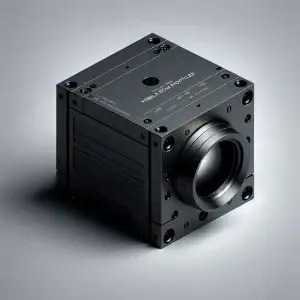
IZAK’s SWIR laser beam profilers cover 400–2050 nm: four models for 400–1760 nm, an extended model to 2050 nm and a fast NIR–SWIR model for 900–1700 nm. They use the same software as the rest of the family: live 2D and 3D profiles, centroid, widths, ellipticity, pass/fail tests and reports. For the basics of beam profiling, start with The Complete Guide to Laser Beam Profiling.
SWIR lasers and the profiler for each
The table lists the lasers most often profiled in the SWIR band and the IZAK family that covers each wavelength.
| Laser | Wavelength | Typical use | IZAK family |
|---|---|---|---|
| Pump diodes | 915–980 nm | Pumping fiber and solid-state lasers | UV–VIS–NIR or SWIR |
| Ytterbium fiber and disk, Nd:YAG | 1030–1080 nm | Cutting, welding, marking, research | UV–VIS–NIR or SWIR |
| Telecom O-band | 1260–1360 nm | Data-center and access optics | SWIR |
| Raman and erbium pumps | 1450–1480 nm | Optical amplifiers | SWIR |
| Erbium fiber, telecom C and L bands | 1530–1625 nm | Telecom, lidar, sensing, eye-safe rangefinders | SWIR; MWIR from 1.5 µm |
| Thulium fiber | 1.9–2.05 µm | Medical (strong water absorption near 1.94 µm), plastics processing, pumping | Extended SWIR (32005) or MWIR |
| Holmium | 2.05–2.1 µm | Medical, mid-IR pumping | MWIR above 2.05 µm |
The SWIR family ends at 2.05 µm and the MWIR family starts at 1.5 µm, so 1.5–2.05 µm is covered by both. Choose by beam size, frame rate and budget, or ask us.
What is different about profiling in SWIR
Alignment by eye is impossible. Use an IR viewer card or a viewer to find the beam, then centre it on the live profile at low power.
SWIR sensors usually have lower pixel counts than visible ones. Small beams need a model with more pixels or a relay lens.
SWIR detectors produce more dark signal, and it changes with temperature and exposure. Take a dark frame at the same settings and subtract it.
Visible-range profilers still respond at 1030–1064 nm, but their sensitivity falls steeply toward 1100 nm and the light spreads deeper in the sensor.
A single-mode fiber at 1550 nm has a mode field about 10 µm wide, too small to image directly. Magnify it onto the sensor.
Fiber lasers in this band reach kilowatts. Sample and attenuate before the sensor, and plan the beam dump for light you cannot see.
Around 1 µm: UV–VIS–NIR or SWIR?
For ytterbium and Nd:YAG lasers at 1030–1064 nm both families can work. A UV–VIS–NIR profiler has more and smaller pixels, which helps with small beams, and only a small part of the laser power is needed even where the sensor is less sensitive. Its limits are signal near 1100 nm and a slight blur: at these wavelengths the light penetrates deep into the sensor before it is absorbed, and the charge spreads to neighbouring pixels. This matters most for small or sharp-edged beams. Above about 1.1 µm, pushing a visible-range sensor with more power gives blooming and wrong widths, so use a SWIR profiler. Our article on small versus large pixels explains how pixel size affects the measured width.
SWIR profiler finder
Enter the wavelength and the beam diameter at the sensor. The finder lists the SWIR models that cover the wavelength and checks two rules: at least 10 pixels across the beam, and the beam no wider than one third of the sensor, so there is room for the background area that ISO 11146 needs.
Not sure of the beam size? Use the Gaussian Beam Calculator to find the diameter at your measurement plane.
Small beams and fiber outputs
Many SWIR measurements are of small spots: the mode field of a fiber, a focused spot or the output of a waveguide. A standard single-mode fiber has a mode field diameter of about 9 µm at 1310 nm and about 10 µm at 1550 nm. With pixels a few micrometres wide that is only two or three pixels, which is not enough to measure a width.
The answer is relay imaging: a lens or microscope objective images the spot onto the sensor with a known magnification M. The profiler measures the magnified width, and the real width is that value divided by M. Three rules keep the result right:
- Choose M for 10 or more pixels across the spot, while keeping the magnified beam under one third of the sensor width. For a 10 µm mode field and pixels of a few micrometres, that is about 4× to 10×.
- Calibrate M, for example by moving a target a known distance or imaging a scale, instead of trusting the nominal value.
- Use optics that do not clip the beam. The lens aperture must collect the full divergence of the fiber output, or the measured spot looks smaller and more Gaussian than it is.
The finder above gives the approximate magnification when the beam is under-sampled. For collimated beams of a few millimetres, the opposite applies: if the beam is wider than one third of the sensor, reduce it with a telescope or choose a model with a larger sensor.
Power, attenuation and safety
A SWIR profiler, like any camera sensor, needs only a tiny part of the beam: typically microwatts to milliwatts spread over the spot, depending on the model and the exposure. Continuous fiber lasers of hundreds of watts or kilowatts need a sampling stage first, a wedge or a pick-off that sends a small, known fraction of the beam to the profiler, then attenuators close to the sensor. Check that the attenuators are made for the wavelength: a filter that is neutral in the visible may not be neutral at 1550 nm or 2 µm. For pulsed SWIR sources, plan exposure and attenuation from the pulse energy, as explained in How to Profile a Pulsed Laser Beam.
Wavelengths above about 1.4 µm are absorbed in the front of the eye and do not reach the retina, which is why lasers near 1.5 µm are called eye-safe. That is relative: the allowed exposure is higher, not unlimited, and high-power SWIR beams still burn skin and eyes. Classify the laser under IEC 60825-1, wear eyewear rated for the wavelength, and remember that a stray reflection you cannot see is still there.
Choosing among the SWIR models
Six configurations cover the band. All are delivered as packaged systems with the IZAK software; the same detectors can also be integrated as an OEM module in your system.
| Model | Spectral range | Sensor width | Resolution | Best for |
|---|---|---|---|---|
| 32001 SWIR Compact | 400–1760 nm | 2.5 mm | 0.3 MP | Small collimated beams and integration where space is tight |
| 32002 SWIR Standard | 400–1760 nm | 5.2 mm | 1.3 MP | General lab work at 1 to 1.7 µm |
| 32003 SWIR High Resolution | 400–1760 nm | 5.3 mm | 3.2 MP | Small spots, fiber outputs with relay optics, beam detail |
| 32004 SWIR Large-Area | 400–1760 nm | 7.1 mm | 5.2 MP | Larger beams with high detail |
| 32005 Extended SWIR Fast | 400–2050 nm | 10.2 mm | 0.3 MP | Thulium lasers to 2.05 µm and large beams |
| 32006 NIR-SWIR Fast | 900–1700 nm | 10.2 mm | 0.3 MP | Large telecom and 1.5 µm beams |
Frame rate and interface are set for each order according to the optical power, beam diameter and integration needs. The SWIR product page has the full configuration of each model.
Checklist: profiling a SWIR laser
- Wavelengthinside the model range; above 2.05 µm use MWIR
- Sampling10 or more pixels across the beam, or relay optics
- Sensor sizebeam under one third of the sensor width
- Dark frametaken at the same exposure and temperature, subtracted
- Attenuationsampling first; filters rated at the laser wavelength
- AlignmentIR card or viewer, then the live profile at low power
- Safetyeyewear for the wavelength, beam dump for invisible light
- Reportwidth definition (D4σ, 1/e²) and magnification stated
Free PDF · 6 pages
Take the selection rules with you
- Wavelength-to-detector map, 0.3 to 12 µm
- Pixel-pitch and sensor-size rules with worked examples
- Pulsed vs CW, attenuation and production QA checklists
- A fill-in specification worksheet for your RFQ
IZAK products for this application
Profilers for SWIR lasers, from the lab bench to integration in your system.
 Beam profiling · 400–2050 nmSWIR Laser Beam ProfilersSix models from 2.5 to 10.2 mm sensor width, for fiber, telecom and eye-safe lasers.View product →
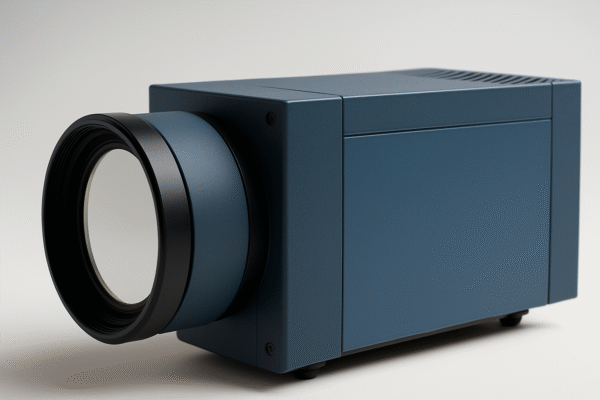 Beam profiling · 1.5–5.7 µmMWIR Laser Beam ProfilersFor holmium lasers at 2.1 µm and mid-infrared sources beyond the SWIR band.View product →
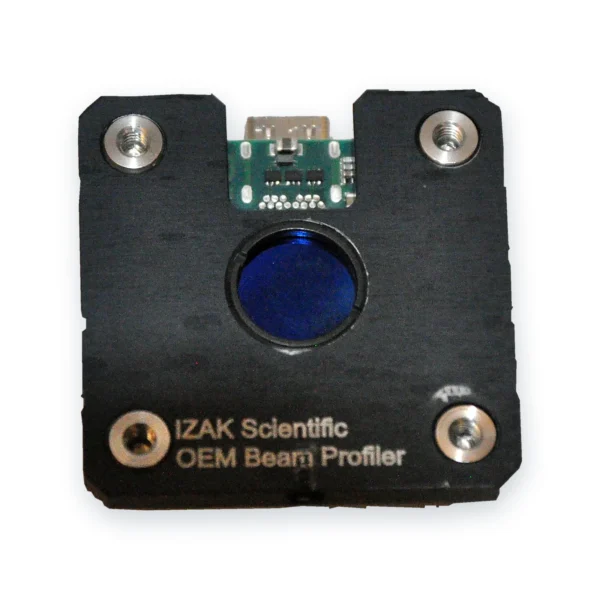 OEM · board levelOEM Board-Level Laser Beam ProfilersCompact profiler modules with the IZAK software, for integration in your system.View product →
Need a SWIR test station that is not in the catalog? We design custom electro-optical systems →
What to send us for a recommendation
With these details an engineer can recommend the model, optics and attenuation in one reply:
- Laser type and wavelengthe.g. erbium fiber laser, 1550 nm
- Power or pulse energyCW power, or energy, width and repetition rate
- Beam sizeat the planned measurement plane, or fiber type
- What you need to measurewidth, M², pointing, mode quality
- InterfaceUSB3 or GigE, cable length, software or API
- EnvironmentR&D bench, OEM integration or production line
Frequently asked questions
QWhat wavelength range does a SWIR beam profiler cover?
QCan I profile a 1550 nm laser with a standard camera?
QWhich profiler should I use for a 1064 nm laser?
QHow do I measure the mode field of a single-mode fiber?
QIs a 2 µm thulium laser SWIR or MWIR?
QAre “eye-safe” SWIR lasers safe to align by eye?
References
- ISO 11146-1: Lasers and laser-related equipment — Test methods for laser beam widths, divergence angles and beam propagation ratios — Part 1: Stigmatic and simple astigmatic beams.
- ISO/TR 11146-3: Part 3: Intrinsic and geometrical laser beam classification, propagation and details of test methods.
- IEC 60825-1: Safety of laser products — Part 1: Equipment classification and requirements.
- ITU-T G.652: Characteristics of a single-mode optical fibre and cable (mode field diameter).
Tzachi Sabati
CEO, IZAK Scientific
Physicist specializing in photonics and quantum technologies, with deep expertise in quantum sensors and advanced optical systems. Leads the Advanced Quantum Lab course at the Technion, bridging academic excellence with industry innovation. At IZAK Scientific, provides cutting-edge photonics-based solutions, developing customized inspection and sensing systems for R&D and production. Passionate about advancing quantum sensing applications and integrating novel technologies to meet industry needs.
