

In short
- Start from your smallest beam. Aim for about 20 pixels across it (10 at the very least). Its diameter divided by 20 is the largest pixel pitch that measures it well without optics.
- Then check your largest beam. Keep it under about one third of the sensor width so the wings are not clipped.
- Small pixels resolve small beams and fine structure, but each pixel collects less light. Large pixels hold more charge, giving more range between noise and saturation, and cover larger beams.
- Pulsed laser? Shutter type matters more than pixel size: use a global-shutter sensor with an external trigger.
Start with the beam, not the camera
A beam profiler measures diameter, centroid and shape by sampling the beam with pixels. If too few pixels fall across the beam, the second-moment (D4σ, ISO 11146) width and the profile shape lose accuracy. Two rules of thumb are used in practice:
So the first question is simple: what is the smallest beam diameter you need to measure, at the plane where you will place the sensor?
What small pixels solve
Small beams without extra optics. At 2–3.5 µm pitch, a sensor measures beams of a few tens of microns directly. That suits focused spots, fiber outputs and compact diode modules, where adding a beam expander changes the setup you are trying to qualify.
Detail inside the profile. More pixels across a structured beam show hot spots, side lobes and diffraction rings that a coarse grid averages away.
Compact integration. Small-pixel sensors are common in board-level cameras, which fit inside test stations and production fixtures.
The cost in signal. At the same irradiance, a pixel with a quarter of the area collects a quarter of the photons. In the shot-noise limit the signal-to-noise ratio per pixel drops by half, so small pixels need longer exposure, more gain or frame averaging on weak beams.
What large pixels solve
Signal range per pixel. Full-well capacity grows with pixel area, so a larger pixel holds more charge before it saturates. That gives more usable range between the noise floor and saturation, which matters when you need to see the low-intensity wings of a beam and its peak in the same frame.
Larger beams on the same pixel count. With 5–10 µm pitch, the same number of pixels covers a larger area. Beams of several millimetres fit without reducing optics, and fewer pixels per frame keep data rates manageable.
The numbers for typical sensors
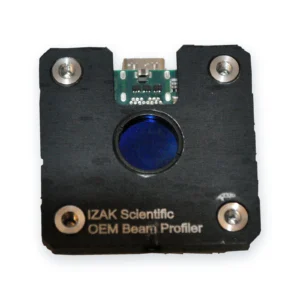
The first five rows are the sensors in the IZAK OEM board-level beam profiler line. The last row is a typical large-pixel sensor, for comparison.
| Pixel pitch | Shutter | Resolution | Active area (mm) | Min. beam, 10 px | Min. beam, 20 px | Largest beam (⅓ width) | Full-frame rate |
|---|---|---|---|---|---|---|---|
| 2.2 µm | Rolling (CW only) | 2592 × 1944 | 5.70 × 4.28 | 22 µm | 44 µm | 1.9 mm | 49 fps |
| 2.74 µm | Global | 2472 × 2062 | 6.77 × 5.65 | 27 µm | 55 µm | 2.3 mm | 49 fps |
| 2.74 µm | Global | 4128 × 3008 | 11.31 × 8.24 | 27 µm | 55 µm | 3.8 mm | 32 fps |
| 3.0 µm | Global | 1920 × 1200 | 5.76 × 3.60 | 30 µm | 60 µm | 1.9 mm | 101 fps |
| 3.45 µm | Global | 1456 × 1088 | 5.00 × 3.75 | 35 µm | 69 µm | 1.7 mm | 235 fps |
| 5.5 µm | Global | 2048 × 2048 | 11.26 × 11.26 | 55 µm | 110 µm | 3.8 mm | model-dependent |
Minimum beam = pixel pitch × 10 or × 20. Largest beam = one third of the active width. Frame rates are full-resolution values.
The table also shows a trade-off that is easy to miss: the 1.6 MP global-shutter sensor delivers 235 full frames per second, while the 5 MP sensors deliver about 49. More pixels mean more data per frame over the same interface. For live alignment or pulse-to-pulse monitoring, a smaller frame is often the better choice. Most sensors also let you read out a region of interest at a higher rate.
Which pixel size fits your beams?
Enter the smallest and largest beam diameters (1/e²) you need to measure at the sensor. The tool gives the largest usable pixel pitch and checks each IZAK OEM board-level sensor against the 20-pixel and one-third-width rules.
Shutter type matters more than pixel size for pulsed lasers
A rolling-shutter sensor exposes rows at different times. For a CW laser this is fine. For a pulsed laser, part of the frame can miss the pulse, so the profile is wrong. Use a global-shutter sensor with an external trigger for pulsed sources, whatever the pixel size.
What about cost?
For a fixed beam range, the sensor format matters more than the package. A complete benchtop profiler adds a housing, mounts, attenuation and a ready-to-run software package, which is what you want in the lab. When the profiler goes inside a test station or a production fixture, an OEM board-level module with the same pixel pitch measures the same beam at a lower cost per channel and in less space. Choose the pixel pitch from your beams first, then the integration level.
How to choose
- Find your smallest beam diameter at the sensor plane. Divide it by 20: that is the largest pixel pitch that measures it well without optics.
- Find your largest beam. It must stay under about one third of the active width, so the wings are not clipped.
- Pulsed laser? Choose global shutter and triggering.
- Need the wings and the peak in one frame? Prefer larger pixels, or use averaging and careful exposure.
- If one sensor cannot cover both your smallest and largest beams, add beam-expanding or reducing optics rather than accept too few pixels.
IZAK Scientific builds laser beam profilers in four families: UV–VIS–NIR (300–1100 nm), SWIR (up to 2.05 µm), MWIR (1.5–5.7 µm) and LWIR (7.7–12 µm). They come as complete instruments and, for the UV–VIS–NIR range, as compact OEM board-level beam profiler modules for integration into your test station. See the Laser Beam Profiler family or the beam profiler selection guide.
Frequently asked questions
QHow many pixels should cover the laser beam?
QAre smaller pixels always better for beam profiling?
QCan I use a rolling-shutter camera for a pulsed laser?
QWhat if my beams are too small or too large for one sensor?
Tzachi Sabati
CEO, IZAK Scientific
Physicist specializing in photonics and quantum technologies, with deep expertise in quantum sensors and advanced optical systems. Leads the Advanced Quantum Lab course at the Technion, bridging academic excellence with industry innovation. At IZAK Scientific, provides cutting-edge photonics-based solutions, developing customized inspection and sensing systems for R&D and production. Passionate about advancing quantum sensing applications and integrating novel technologies to meet industry needs.
