

In short
- Radiometry measures all the radiation – UV, visible and IR – in physical units: watts, W/sr, W/m².
- Photometry measures light as the eye sees it (about 380–780 nm). It weights the spectrum with the eye’s sensitivity curve V(λ) and reports lumens, candela, lux and cd/m².
- One factor links them: 683 lm per watt at 555 nm in daylight (photopic) vision, 1700 lm/W at 507 nm in night (scotopic) vision, and less at every other wavelength. The converter below does the sum for you.
- Instruments: radiometers measure total power, spectro-radiometers measure the full spectrum and can compute both radiometric and photometric values, and radiometric imaging maps radiation across a scene.

Introduction
Radiometry is a cornerstone of optical science. From its beginnings in the late 19th century it has grown into a central tool of modern science and technology, because it lets us quantify electromagnetic radiation well beyond the range the eye can see. Its importance spans scientific research, industrial processes and environmental monitoring.
This article explains radiometry and its human-centred counterpart, photometry: their units, how they differ, the instruments that measure them, how those instruments are calibrated and where both are used.
What is radiometry?
Radiometry is the science of measuring electromagnetic radiation, including light. Unlike photometry, which deals only with what the human eye perceives, radiometry covers all wavelengths: visible light as well as ultraviolet, infrared and beyond. That breadth makes it valuable in many scientific and industrial fields.
Radiometric quantities describe the physical power of the radiation, regardless of who or what is looking at it:
Total optical power emitted, transmitted or received, in watts (W).
Power per unit solid angle in a given direction, in watts per steradian (W/sr).
Power received per unit area, in watts per square metre (W/m²).
Power per unit area per unit solid angle, in W/(sr·m²). It describes how bright a surface is in a given direction.
Photometry
Photometry is the measurement of visible light as the human eye perceives it. It is closely related to radiometry but deals only with the visible range, about 380 to 780 nanometres. This section covers its principles, its units and how it differs from radiometry.
Principles of photometry
Photometry is based on the sensitivity of the human eye, which changes across the visible spectrum:
In well-lit conditions the eye is most sensitive to green-yellow light, around 555 nm. The photopic curve V(λ) peaks there, where 1 W of light equals 683 lm.
In low light the sensitivity shifts towards blue-green, around 507 nm. The scotopic curve V′(λ) peaks there, where 1 W equals about 1700 lm.
Photometric measurements are weighted by a luminosity function that models this sensitivity, so the results match human visual perception. For a source with spectral power Φe,λ(λ), the luminous flux is
Φv = 683 lm/W · ∫ Φe,λ(λ) · V(λ) dλ
The same weighting turns radiant intensity into luminous intensity, irradiance into illuminance and radiance into luminance.
Key photometric units
The photometric equivalent of radiant flux, in lumens (lm). It represents the light power as the eye perceives it.
The photometric equivalent of radiant intensity, in candela (cd = lm/sr). It shows how much light a source emits in a given direction.
The photometric equivalent of irradiance, in lux (lx = lm/m²). It is the luminous flux received per unit area.
The photometric equivalent of radiance, in candela per square metre. It describes how bright a surface looks from a given direction, and is the key value for displays.

By building the human response into light measurement, photometry aligns scientific measurement with what people actually see, and makes it practical for daily life and technology.
Differences between photometry and radiometry
Radiometry measures the total electromagnetic radiation without regard to the sensitivity of the eye. Photometry measures light as the eye perceives it, applying a weighting function that mimics the eye’s response at each wavelength. The two are distinct but complementary: radiometry gives a complete physical assessment of the radiation, and photometry adds the human visual response.
Same source, two answerswhy units matter
A 1 W green laser at 555 nm gives 683 lm. A 1 W red laser at 650 nm gives only about 73 lm, and a 1 W near-IR laser at 850 nm gives practically zero lumens, although it delivers the same power to a detector, or to the eye’s retina. That is why eye-safety, solar and detector work uses radiometric units, while lighting and display specifications use photometric ones.
Radiometric ↔ photometric pairsW → lm, W/sr → cd, W/m² → lx, W/(sr·m²) → cd/m²
Each radiometric quantity has a photometric twin. For a single wavelength the conversion is one factor, 683 · V(λ) lm/W; for a real source the factor is the spectrum-weighted average, the luminous efficacy of radiation.
Together, radiometry and photometry cover the full range from purely physical to perceptual measurement, supporting applications from scientific research to lighting and display design.
Radiometric ↔ photometric converter
Convert watts to lumens, W/sr to candela, W/m² to lux or radiance to cd/m², and back. Choose daylight (photopic) or night (scotopic) vision, enter the peak wavelength and the spectral width: 0 nm for a laser line, about 15–35 nm for a coloured LED.
Model: K = Km · ∫S(λ)V(λ)dλ / ∫S(λ)dλ, with Km = 683 lm/W (photopic) or 1700 lm/W (scotopic), CIE luminosity functions tabulated every 10 nm and interpolated linearly, and a Gaussian spectrum S(λ) of the given FWHM (a single line when FWHM = 0). Real LED spectra are asymmetric and white LEDs are not Gaussian; for those, measure the spectrum with a spectro-radiometer and integrate it.
What is a radiometer?
Radiometers are instruments that measure electromagnetic radiation. They range from simple devices that measure overall light intensity to sophisticated systems that resolve specific frequencies of radiation. Their key components are detectors, filters and calibration systems, which together make precise radiometric measurements possible.
What is a spectroradiometer?
Spectroradiometers extend radiometry by measuring the spectral power distribution of a light source, which allows a detailed analysis at each wavelength. This sets them apart from general radiometers and supports precise work in colorimetry, photosynthesis research and atmospheric studies. Because they record the whole spectrum, they can also compute photometric values exactly, by applying V(λ) in software instead of relying on a filter that only approximates it.
Radiometric imaging
Radiometric imaging combines imaging technology with radiometric measurement to show how radiative properties are distributed across a scene. It is fundamental to thermal imaging for medical diagnostics and to remote sensing for environmental assessment, and it gives unique insight into physical and biological processes.
Methods in radiometric calibration
Calibration is the key to radiometric accuracy. It keeps measurements consistent and traceable to standards. The techniques range from calibrated reference light sources to mathematical corrections of the instrument’s response, and they underpin the reliability of radiometric data in every application.

Applications of radiometry and photometry
Radiometry is used across many fields:
Radiometry plays a key role in observing Earth’s climate dynamics and atmospheric composition.
Infrared radiometry supports non-invasive diagnosis and monitoring.
The study of celestial bodies relies on radiometric techniques across the electromagnetic spectrum.
Applications of photometry
Photometry is widely used wherever human visual perception matters:
Making sure workspaces, public areas and homes are lit adequately and efficiently.
Evaluating and optimising the brightness, contrast and colour of screens and displays.
Measuring the brightness of celestial objects as the human eye perceives it.
Ensuring consistent colour and brightness in products that emit or reflect light, such as indicator LEDs, as described in Radiometry and LED Quality.
Radiometry in testing
In materials science, radiometry is used to analyse reflectance, transmittance and other properties that matter when developing new materials. Manufacturing benefits from radiometric testing for quality assurance, which keeps products consistent and performing as specified. A common example is total-flux and spectrum testing of LEDs in an integrating sphere, explained in LED Inspection Part 1: Integrating Sphere; the choice of detector for such measurements is covered in Optical Sensors in Radiometry.
Industrial applications of radiometry
Radiometry improves industrial work through precise monitoring and control, from manufacturing to agriculture, where it supports crop management and disease detection. This versatility has a direct, positive effect on efficiency and productivity.
Advances and future directions
Technological progress keeps expanding what radiometry can do. More sensitive sensors, better data analysis and the integration of artificial intelligence are opening new areas of research and application, and further breakthroughs are expected in environmental science, medical imaging and beyond.
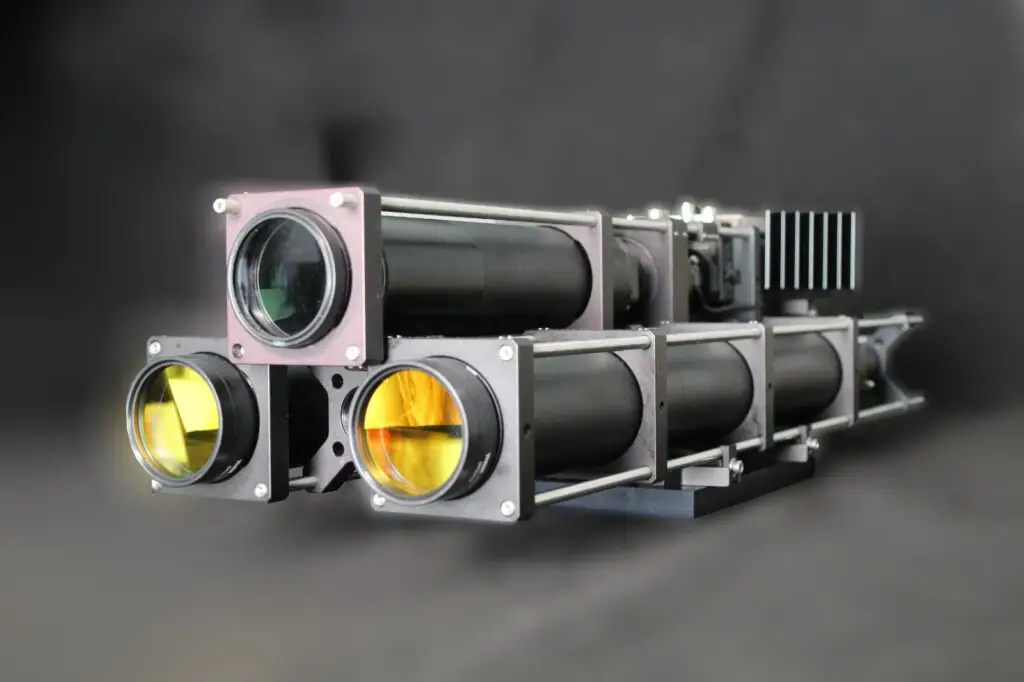
The IZAK Multi-Channel Spectro-Radiometer combines the functions of a radiometer, a spectroradiometer and a photometer, with its own software. It measures from the visible into the infrared and records several wavelengths simultaneously, for industrial quality control, environmental monitoring and research.
Conclusions
Radiometry has grown from an emerging science into a core part of modern research and industry, and photometry translates its physical measurements into what people see. Continued research and technological development will keep producing new insights and innovations in both.
References
For readers who want to go deeper into radiometric formulas, measurement and applications:
Textbooks
- Boyd, R. W. Radiometry and the Detection of Optical Radiation. An introduction to the principles of radiometry and the techniques for measuring optical radiation.
- McCluney, R. Introduction to Radiometry and Photometry. An overview of both fields and their applications.
- Born, M., & Wolf, E. Principles of Optics. A classic optics text that covers radiometric quantities.
Journal articles
- “Fundamentals of Radiometry,” Journal of the Optical Society of America. A review of the basic principles of radiometry and how to interpret measurements.
- “Advances in Radiometry for Optical Radiation Measurements,” Applied Optics. Recent radiometric methods and technologies.
- “Spectral Radiance Calibration: Methods and Protocols,” Journal of Quantitative Spectroscopy & Radiative Transfer. Calibration methods and guidelines.
Professional resources
- International Commission on Illumination (CIE) publications: lighting standards, guides and technical reports on radiometry and photometry.
- National Institute of Standards and Technology (NIST), optical technology: standards, calibration services and measurement protocols.
Online resources
- “Radiometry and Photometry FAQ,” Optical Society of America (OSA): answers to common questions and definitions of basic terms.
- “Tutorial on Radiometry and Calibration,” NASA: radiometry principles and instrument calibration for remote sensing.
Frequently asked questions
QWhat is the difference between radiometry and photometry?
QHow do I convert watts to lumens?
QShould I use a photometer or a spectroradiometer?
Tzachi Sabati
CEO, IZAK Scientific
Physicist specializing in photonics and quantum technologies, with deep expertise in quantum sensors and advanced optical systems. Leads the Advanced Quantum Lab course at the Technion, bridging academic excellence with industry innovation. At IZAK Scientific, provides cutting-edge photonics-based solutions, developing customized inspection and sensing systems for R&D and production. Passionate about advancing quantum sensing applications and integrating novel technologies to meet industry needs.
