

In short
- The task: inspect bare LED chips of a driver-assistance product for homogeneous illumination and exact shape, in mass production.
- The design: four units under test (UUTs) per batch on a fast-loading shelf, connectors rated above one million insertions, door interlocks and fully automated software.
- The tests: LED function, colour and brightness, uniformity and light leakage, shape-mask matching, per-pin current and buzzer frequency.
- The result: batches in under 30 seconds, more than 1 million connector insertions without failure, and repeatable results in a noisy factory.

Following our earlier article on LED inspection with an integrating sphere, this case study presents an LED and shape inspection system that IZAK Scientific developed for high-volume production. The system reflects our commitment to innovation, quality and efficiency, and it was built for the daily needs of quality assurance, engineering and production managers.
Project overview
A leading developer of advanced driver-assistance systems (ADAS) needed an inspection system for the bare LED chips in its product. The system had to verify homogeneous illumination and precise shape conformity, and it had to run seamlessly in a mass-production setting.
Key requirements included:
A few tens of seconds per batch of four units.
Components, especially the connectors, must withstand more than 1 million fast insertions and removals.
Reliable operation in a noisy industrial environment.
Several tests, including power consumption, LED luminance and buzzer function, with precise and repeatable results.
System design and components
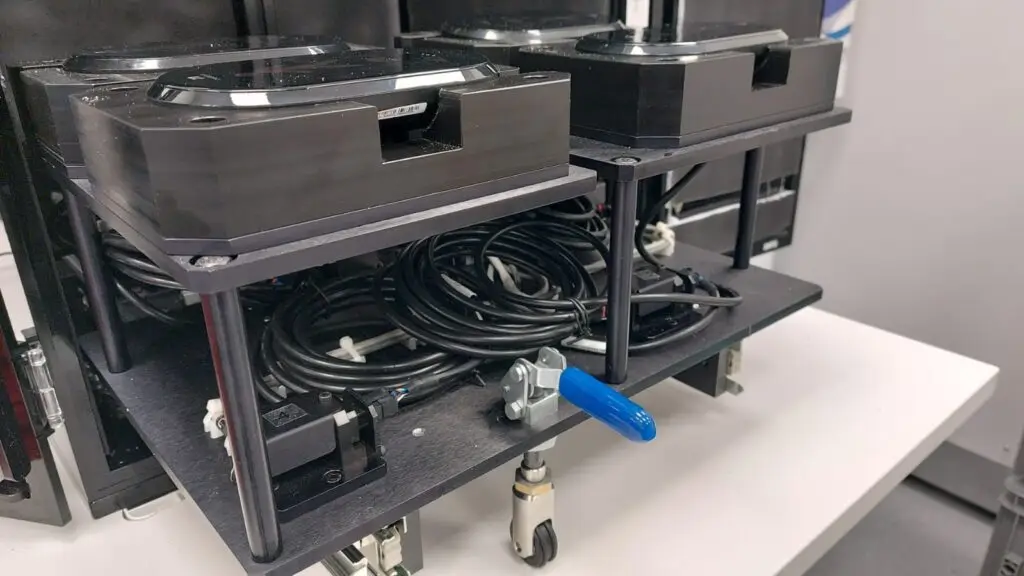
To meet the speed requirement, IZAK Scientific designed the system to inspect four UUTs at the same time. The UUTs sit on a fast-loading shelf system, so they can be loaded and removed quickly.
- High-durability connectors: specially designed connectors that withstand more than one million insertions and removals, for long-term reliability.
- Batch inspection: up to four UUTs are inspected at once, which raises throughput significantly.
Inspection states
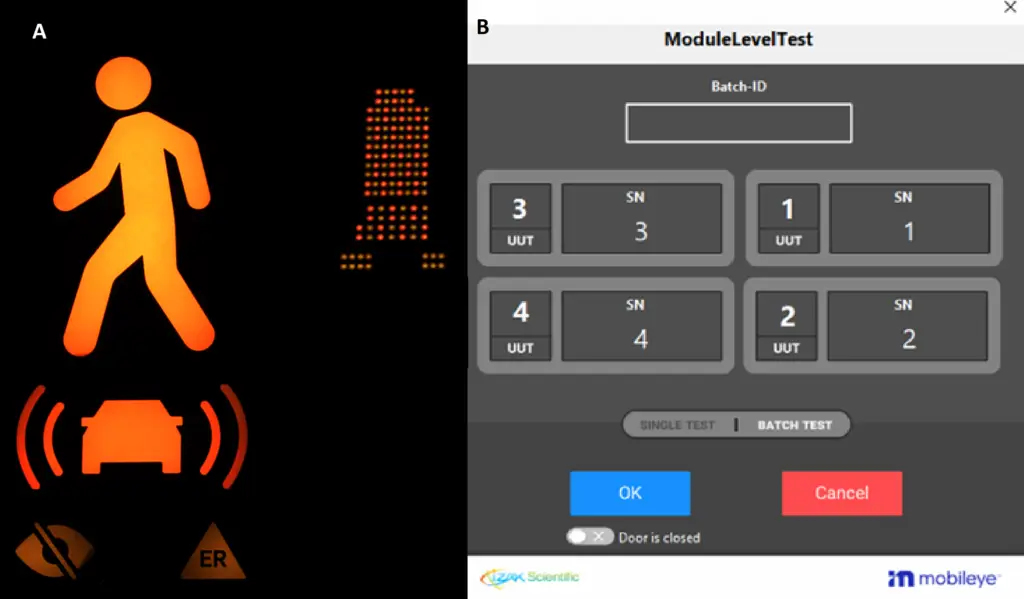
1. Bare LED matrix inspection
- Each LED is inspected for proper operation.
- The LEDs are tested for correct colour and brightness.
- Other performance metrics are evaluated as well.
2. Optical shape inspection
- Uniformity and homogeneity: checks for uniform illumination across the chip surface, with no light leakage and consistent brightness.
- Shape mask verification: captures the shape of the lit LED and compares it with predefined templates to confirm conformity.
Additional tests
- Current and power consumption: confirms that each pin draws less than the specified current.
- Buzzer test: verifies that the on-board buzzer sounds at the specified frequencies when alert signals are activated.
Implementation and testing
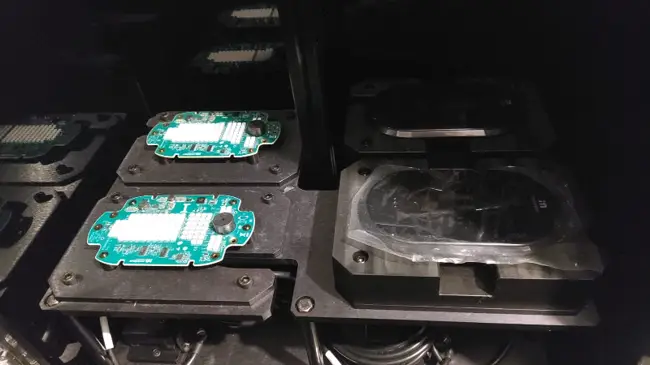
Installation and set-upbench, shelves, harnesses
- The cabinet is secured to a workbench for stability.
- The shelves carry UUT beds and PCB standoff holders for secure placement.
- Each UUT connects to the power supply and the imaging system through labelled harness connectors.
Testing procedurefour UUTs, interlocked, automated
- Up to four UUTs are tested at the same time.
- A test starts only when all safety interlocks confirm that the cabinet doors are closed.
- IZAK’s software automates power-supply control, image acquisition and result logging.
Verification and validationcurrent, image, frequency
- The current of each pin is monitored. A pin that exceeds the limit at a specific voltage fails the test.
- The imaging system captures the LED outputs and compares them with the expected results for brightness and shape.
- The buzzer’s frequency output is measured against the required frequencies.
Test station throughput and connector life planner
Plan a batch test station like this one. Enter the batch size, the test time, the load and unload time and your shift pattern. The tool returns the cycle time, units per hour and per day, and how long the test connectors last at their rated number of insertions (one insertion per unit tested in each position).
Cycle = test + handling. Units per hour = batch × 3600 / cycle. Connector insertions per position per day = units per day / batch. Life = rating / insertions per day. Plan spare connectors well before the rated life.
Case study results
The system met all the project requirements and delivered strong performance and reliability:
- Durability: the fast connector lasted more than 1 million insertions without failure.
- Speed and efficiency: batch tests consistently finished in under 30 seconds, keeping throughput high.
- Reliability: despite the noisy industrial setting, results were accurate and repeatable, independent of the light and acoustic background.
Conclusion
This case study shows IZAK Scientific’s expertise in robust, efficient, high-speed LED inspection systems. These solutions improve production efficiency and product quality, and they are designed around the needs of QA and engineering managers in high-volume production. For the radiometric background and a pre-shipment LED and display tester, read Radiometry and LED Quality; for line integration, see How to Embed an LED Checker into Your Production Line.
Discover how the inspection systems of IZAK Scientific can benefit your production line: start with our LED tester, or ask for a custom station through our electro-optics design and development service.
Frequently asked questions
QHow do you test LED uniformity and shape in production?
QHow can an LED test station reach a short cycle time?
QHow long do test-fixture connectors last?
Tzachi Sabati
CEO, IZAK Scientific
Physicist specializing in photonics and quantum technologies, with deep expertise in quantum sensors and advanced optical systems. Leads the Advanced Quantum Lab course at the Technion, bridging academic excellence with industry innovation. At IZAK Scientific, provides cutting-edge photonics-based solutions, developing customized inspection and sensing systems for R&D and production. Passionate about advancing quantum sensing applications and integrating novel technologies to meet industry needs.
