


In short
- Indication LEDs are everywhere: small, low-power and low-maintenance, from traffic signals to keyboards and car dashboards.
- Color and placement matter when one board carries several LEDs of different colors.
- An LED color tester checks operation under each power option, placement order and color against the configuration.
- Batch pass/fail: the tester learns the layout once, tests the whole batch and writes the results to a CSV file.
Why LED color matters for products with indication LEDs
LEDs are the most common status indicators in electronics because they are small, need little maintenance and use little power. Examples include traffic signals, exit signs, keyboards, device power indicators and automotive indicators.
Correct color and placement matter when a board uses several LEDs of different colors. Manufacturers therefore use an LED color tester to check the operation, position, order and color of each LED.
When should you use an LED color tester?
During PCB manufacturing, makers must confirm that each LED works and that its color suits its indication role. The tester checks placement, function and order. In a circuit it evaluates:
- the operation of the LEDs under the various power options;
- the correct placement order of the LEDs;
- the correct LED colors for the configuration.
Testing with the tester helps ensure board quality and removes manufacturing defects before the boards are built into products.

How likely is a 37-LED board to carry at least one faulty LED? Estimate it for your own boards with the calculator in What is LED functionality, and how can it be tested? If two of your LED colors are very close, check whether an imager can separate them with the tool in LED tester: who needs it?
How do you know whether the batch passed or failed?
Manufacturers use the tester to confirm that a batch matches the original LED configuration. Most LED testers use optical fibers; IZAK’s tester needs no optical fiber and tests a whole batch of PCBs. It has three functions:
Captures a live image of the PCB, or loads an existing image.
Saves the LED layout to a configuration file, so a machine-learning model learns the correct positions.
Checks the manufactured boards against the learned configuration and writes the results to a .csv file.
Testing the full batch shows whether assembly was correct. The accurate results reduce LED placement and order errors.
Where the test sits in the line, and how it talks to your tester, is covered in how to embed an LED checker into your production line. If you also need luminous flux or spectral measurements of the LEDs themselves, see LED inspection part 1: the integrating sphere.
Watch: the LED tester checking colour and position
Customer story: LED color and position tester in a production test system
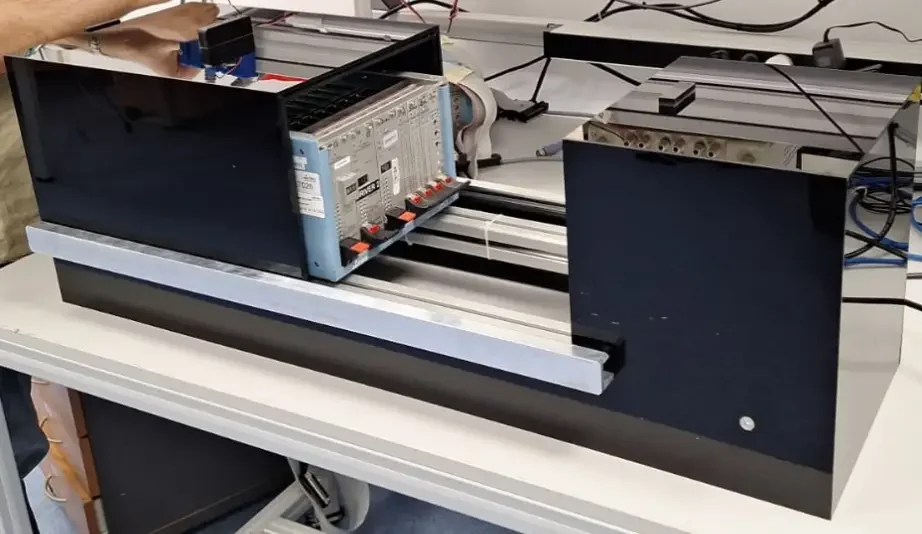
A global manufacturer of semiconductor-equipment subsystems bought an LED color and position tester from IZAK Scientific after several successful earlier projects with our team. They needed to test PCBs that carry several LED configurations each.
IZAK supplied the recognition API as a DLL with a ready C integration example, which the customer integrated into its own tester software, and a tester box with an imager, optics and relays.
What the customer said
“A simple, easy-to-learn machine-learning tool that learns a new PCB in minutes and tests quickly in a free-space configuration.”“We received customized full service and support. This was one of several projects with IZAK, and the team was professional and delivered on time.” Moshe Aizler, Testing Development Manager, Automation & Control Solutions, MKS InstrumentsFrequently asked questions
QWhy use an LED color tester for indication LEDs?
QWhen in production should LED color be tested?
QHow does the tester decide pass or fail?
Tzachi Sabati
CEO, IZAK Scientific
Physicist specializing in photonics and quantum technologies, with deep expertise in quantum sensors and advanced optical systems. Leads the Advanced Quantum Lab course at the Technion, bridging academic excellence with industry innovation. At IZAK Scientific, provides cutting-edge photonics-based solutions, developing customized inspection and sensing systems for R&D and production. Passionate about advancing quantum sensing applications and integrating novel technologies to meet industry needs.
