
Description
PXL Sanitizer · Pulsed UV light disinfection
PXL Sanitizer: Light Disinfection for Bacteria and Viruses
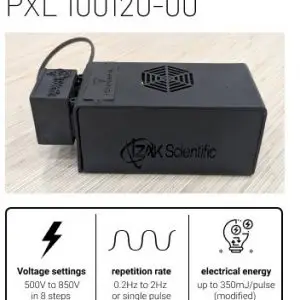
A compact pulsed-UV sanitizer for shared surfaces. A mercury-free xenon flash lamp delivers short, intense broadband pulses that include the 200–280 nm UV-C band. In third-party laboratory tests it reduced antibiotic-resistant MRSA by 7.03 log in 30 seconds of illumination.
Where to use it
For the surfaces everyone touches
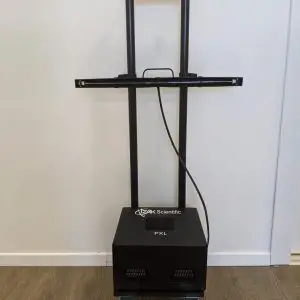
Easy to operate, compact and powered by battery or a direct electrical connection. The sanitizer can be mounted above the surface it disinfects, for example over a fridge or a countertop.
- Handles and door pulls
- Toilet seats and bathrooms
- Keyboards and computer mice
- Plates, pens and remote controls
- Shared tools in kitchens and food and drink areas
- Food and beverage industry work surfaces
Laboratory results
Tested by an independent microbiology laboratory
A third-party analytical microbiology laboratory tested the PXL Sanitizer on surfaces. It virtually eliminated antibiotic-resistant bacteria, and the effectiveness increased with longer illumination time.
Test 1: MRSA (ATCC 700699), inoculum 655,000,000 CFU/ml
| Treatment time | CFU/sample | Log | Log reduction | Reduction |
|---|---|---|---|---|
| Control (non-treated) | 65,000,000 | 7.81 | N/A | N/A |
| 1 second | 960 | 2.98 | 4.82 | 99.998% |
| 6 seconds | 360 | 2.56 | 5.25 | 99.999% |
| 18 seconds | 91 | 1.96 | 5.85 | 99.9999% |
| 30 seconds | 6 | 0.78 | 7.03 | 99.99999% |
Test 2: Bacillus subtilis (ATCC 6633), inoculum 28,500,000 CFU/ml
| Treatment time | CFU/sample | Log | Log reduction | Reduction |
|---|---|---|---|---|
| Control (non-treated) | 2,250,000 | 6.35 | N/A | N/A |
| 1 second | 7,500 | 3.88 | 2.47 | 99.67% |
| 6 seconds | 465 | 2.67 | 3.68 | 99.98% |
| 18 seconds | 360 | 2.56 | 3.79 | 99.98% |
| 30 seconds | 9 | 0.95 | 5.40 | 99.9996% |
Log reduction = log of the untreated control minus log of the treated sample; a 5-log reduction leaves 1 in 100,000 colony-forming units. Results are for the laboratory test conditions; real-world results depend on exposure time, distance and whether the light reaches the microorganisms.
How it works
Pulsed UV versus continuous UV
- Store the energy
Electrical energy is stored and compressed into short pulses that energize a mercury-free xenon flash lamp.
- Flash the surface
Each flash lasts microseconds and is broadband, from deep UV to infrared, including the germicidal 200–280 nm UV-C band.
- Inactivate microorganisms
Ultrashort, intense pulses inactivate microorganisms more effectively and faster than continuous UV light, and longer illumination increases the reduction.
| Pulsed UV (PXL Sanitizer) | Continuous UV lamp | |
|---|---|---|
| Light source | Mercury-free xenon flash lamp | Continuous-wave UV lamp |
| Output | Ultrashort, intense broadband pulses including 200–280 nm UV-C | Steady, lower-intensity emission |
| Inactivation | More effective and faster | Slower; needs longer exposure |
| Chemicals | No chlorine by-products, non-corrosive | No chemicals |
The sanitizer is built on IZAK’s pulsed xenon technology; for research and OEM use, see the PXL Scientific pulsed xenon lamp module and our guide to applications for pulsed flash lamps.
The science
About UV light disinfection
UV light disinfection can help reduce the transmission of some bacteria and viruses when it is applied correctly and safely.
Effectiveness: what studies show
A 2018 peer-reviewed study reported that far-UVC light has bactericidal properties and can prevent the transmission of drug-resistant agents. Earlier studies reported UVC effects on Gram-positive and Gram-negative bacteria, including S. aureus, E. coli, Salmonella, MRSA, VRE and Klebsiella pneumoniae ATCC 700721.
Coronaviruses
UV light in the 200–280 nm range inactivated the coronaviruses SARS-CoV-1 and MERS-CoV under controlled laboratory conditions. Whether this applies to SARS-CoV-2 in real use depends on the exposure time and on whether the UV-C actually reaches the virus.
Pulsed light
Pulsed UV uses ultrashort, intense broadband pulses that include the 200–280 nm UV-C band, and studies report faster and more effective inactivation of microorganisms than with continuous UV light.
Safety
UV-C is for surfaces, not people
Limit human exposure and use UV-C only on surfaces and spaces. Research found that UV-C in a specific range did not cause skin damage, but exposure should still be avoided. Read the safety guide before use; training and safety equipment are included.
FAQ
Frequently asked questions
How long should a surface be illuminated?
Longer illumination gives a higher reduction. In the laboratory tests above, 1 second reduced MRSA by 4.82 log and 30 seconds by 7.03 log; the more resistant B. subtilis needed 30 seconds for a 5.40 log reduction.
Is the PXL Sanitizer safe to use around people?
No. UV-C can damage skin and eyes, so it is used on surfaces and spaces, not on people, and exposure should be avoided. Follow the safety guide; training and safety equipment are included.
Does it contain mercury or use chemicals?
No. The light source is a mercury-free xenon flash lamp, and pulsed light leaves no chlorine by-products and is non-corrosive.
How is it powered and installed?
The sanitizer is compact and runs on battery or a direct electrical connection. It can be mounted above the surface it disinfects, for example above a fridge or a countertop.
Does it work against SARS-CoV-2?
UV-C in the 200–280 nm range inactivated the related coronaviruses SARS-CoV-1 and MERS-CoV in controlled laboratory conditions. Real-world effectiveness depends on exposure time and on whether the UV-C reaches the virus, so we make no claim beyond these findings.
References
Published studies
The background above is based on peer-reviewed studies. Links open the original publications.
Disinfect your shared surfaces
Tell us which surfaces you need to treat, how often and how the device should be mounted and powered. We reply with a configuration and an estimate.
Tzachi Sabati
CEO, IZAK Scientific
Physicist specializing in photonics and quantum technologies, with deep expertise in quantum sensors and advanced optical systems. Leads the Advanced Quantum Lab course at the Technion, bridging academic excellence with industry innovation. At IZAK Scientific, provides cutting-edge photonics-based solutions, developing customized inspection and sensing systems for R&D and production. Passionate about advancing quantum sensing applications and integrating novel technologies to meet industry needs.