

In short
- LEDs carry information. Power, status and fault indications must show the right color, in the right place and order.
- An LED lab test system checks every board. It finds dark, damaged, misplaced and wrong-color LEDs after assembly.
- Two approaches. An imager with a lens checks color and position fast; a spectrometer measures color in nm for tight limits.
- No fibers. IZAK’s LED color and position tester images the board in free space and connects to your test software through an API.

What is an LED lab test system?
LEDs indicate the status of a system, so they must be tested in their final application, on the assembled board, for quality and safety. Manufacturers check whether each LED works, where it sits, its color and its order. Testing LEDs on PCBs needs a proper LED lab test tool.
An LED test system screens each new batch of PCBs for damaged, misplaced or wrong-color LEDs. It evaluates:
- LED function: every LED lights in each power state.
- LED placement: each LED sits where the configuration says.
- Color and order: the right color in the right sequence on the PCB.
For a step-by-step view of what “functional” means for an LED and how the test runs, see What is LED functionality, and how can it be tested?
Which industries benefit from LED lab test systems?
LEDs are used for indication and lighting in almost every electronic system, so LED test systems suit almost every device maker. Any industry that places LEDs on PCBs needs these tests to catch defects and misplacement before shipping.
Status and power LEDs on controllers, instruments and consumer electronics.
Indicators on power supplies, switchgear and appliances.
Dashboard, cabin and control-panel indicators that must match the specified color.
Keyboards, network equipment, storage and docking stations.
Lighting boards and modules with many LEDs, where one dark or off-color LED is visible.
Any product where an LED tells the user something.
LED lab test approach: imager or spectrometer?
The system uses one of two approaches. The choice depends on how sensitive the color check must be.
- Imager with a lens. A sensor with a lens, placed in the optomechanical space above the board, checks color and placement quickly and efficiently. One image covers many LEDs.
- Spectrometer. A spectrometer measures the color of each LED in nanometers and checks it against the circuit configuration. Use it when the color limits are tight. For multi-channel spectral measurement, see our multi-channel spectro-radiometer.
IZAK Scientific offers LED color recognition API products for both approaches, so each manufacturer can choose by its needs.
IZAK’s LED color recognition API checks function, position and color use on the board. Unlike most fiber-based LED testers, it needs no optical fiber connection to each LED: the imager sees the whole board, and a new layout is learned in minutes.
Can an imager tell your two LED colors apart?
Enter the peak wavelength and spectral width (FWHM) of two LEDs from their datasheets. The tool computes their CIE 1931 chromaticity, the color difference Δu′v′ and suggests the test approach.
Model: each LED spectrum is a Gaussian with the given peak and FWHM, integrated with the CIE 1931 2° color-matching functions (380–780 nm) to x, y; u′ = 4x/(−2x+12y+3), v′ = 9y/(−2x+12y+3); Δu′v′ is the distance between the two points. Guide values: Δu′v′ ≥ 0.04 clearly different, 0.01–0.04 close, below 0.01 near-identical. Real LEDs are slightly asymmetric, and white (phosphor) LEDs need their measured spectrum. Swatches are approximate.
Watch: the LED tester checking colour and position
Customer story: LED color and position tester in a production test system
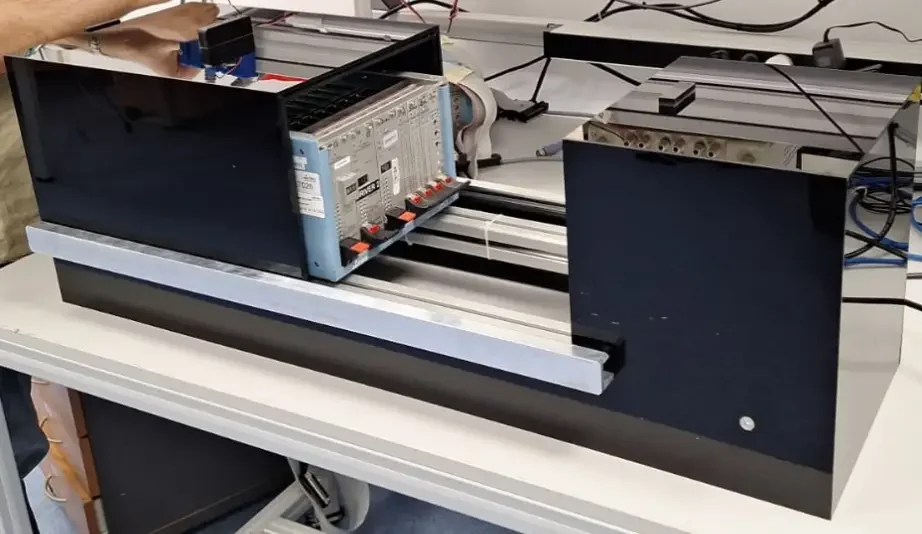
A global manufacturer of semiconductor-equipment subsystems bought an LED color and position tester from IZAK Scientific after several successful earlier projects with our team. They needed to test PCBs that carry several LED configurations each.
IZAK supplied the recognition API as a DLL with a ready C integration example, which the customer integrated into its own tester software, and a tester box with an imager, optics and relays.
What the customer said
“A simple, easy-to-learn machine-learning tool that learns a new PCB in minutes and tests quickly in a free-space configuration.”“We received customized full service and support. This was one of several projects with IZAK, and the team was professional and delivered on time.” Moshe Aizler, Testing Development Manager, Automation & Control Solutions, MKS InstrumentsRead next: LED color tester for products with indication LEDs and how to embed an LED checker into your production line.
Frequently asked questions
QWho needs an LED tester?
QShould I test LED color with a camera or a spectrometer?
QDoes the IZAK LED tester need optical fibers?
Tzachi Sabati
CEO, IZAK Scientific
Physicist specializing in photonics and quantum technologies, with deep expertise in quantum sensors and advanced optical systems. Leads the Advanced Quantum Lab course at the Technion, bridging academic excellence with industry innovation. At IZAK Scientific, provides cutting-edge photonics-based solutions, developing customized inspection and sensing systems for R&D and production. Passionate about advancing quantum sensing applications and integrating novel technologies to meet industry needs.
